There must be something in the water here. Every village we stop at seems to be teeming with artists and artisans. Even Madame Bèrard, our landlady, is an artist. Her creations are exceptional. In fact, she made most of her own serving dishes as well as all the paintings hanging in our apartment. Now she is taking on sculpting, with the help of some lessons at Chusclan's own art studio.
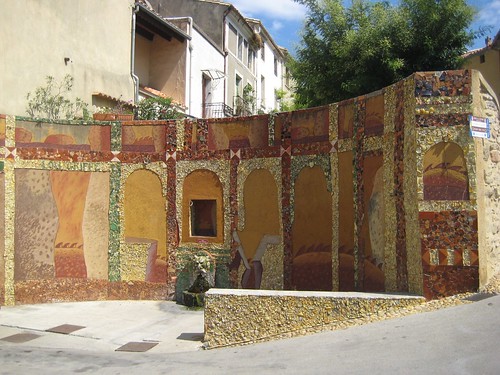
If you're not as talented, you can visit a town with over 20 pottery studios. St. Quentin la Poterie is a typical enclave of creative minds. The town itself even features several public art pieces, including the pictured mosaic. Bring your credit card, however. Beauty doesn't come cheap, even here in France.
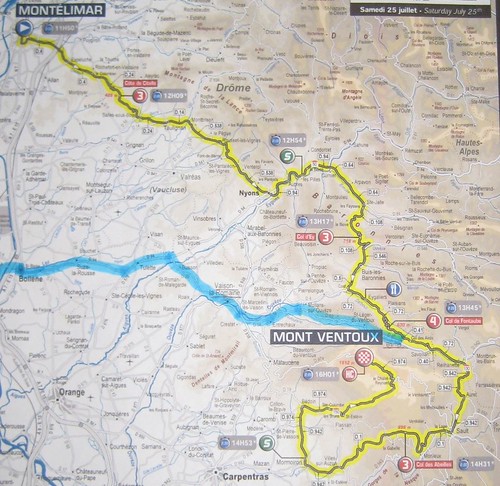
When I heard that the Tour de France was coming near our home, I knew this was an event not to be missed. The 20th and last meaningful leg before the victory lap along the Champs Elysees challenged the riders to climb 1800m to the summit of Mt. Ventoux. Since we can see the "Giant of Provence" from Chusclan, I didn't think we'd have a problem finding the perfect vantage point on race day.
In the days leading up to the event, it seemed that the country was getting race fever. An unexpectedly large crowd had already assembled at the lunar-like mountain summit. The only road leading to the top was closed 48 hours before the race was even set to begin. Carefully reviewing the tour map, we decided that plan-B would take us to one of the small villages just before the grand ascent began.
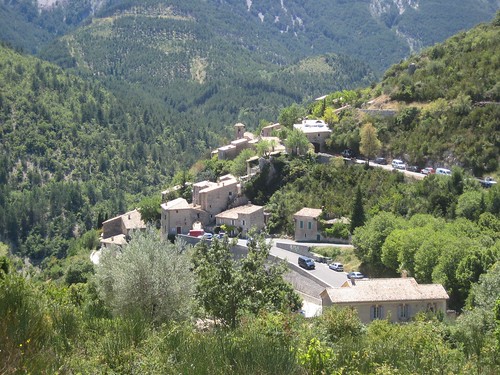
We gave ourselves about four hours to reach the race and find a suitable spot. Although our destination was seemingly nearby, Mapquest suggested a two hour drive. We knew there would be lots of winding roads through the foothills of the mountain. However, we were surprised to find numerous villages perched on rocky outcroppings. Our final destination, Brantes, was one such quaint village built into the side of a steep hill.
Continuing up a narrow winding road, we knew we were getting close to the tour route when makeshift overflow parking lots were found in farmers' fields. After re-applying sun screen and digging our sandwiches out of the cooler, we hiked the last half-kilometer to the course. On the way, we could hear children shouting and horns being sounded. Could we have been too late?
Rushing up to the road, we saw a fast moving parade of vehicles decked out with the tour sponsors' logos. And they were passing out free stuff! We quickly found a position along a bend in the road and joined in the cheers, hoping to come away with some of the swag. The vehicles were moving fast, so you had to react quickly to the flying freebies. On several occasions, my kick save was just a little too slow. All I managed to snag was a cheap noise-maker and a newspaper. Mary Ann and her Mom walked away with the grand prize, a cap with red polka-dots from Carrefour, an hyper-marché chain (kinda like Meijers).
Long after the sponsors had moved on, people continued cheering for every car that passed along the route - no doubt hoping for more free stuff. For more than an hour various tour officials, team representatives and members of the press corps were shuttled along the course in the official sponsor cars. Occasionally, the gendarmerie, a special national police force, would drive by imploring spectators to stand back from the road. This worked for about 5 seconds, before everyone moved in again, angling for position.
Just when we couldn't take the wait any longer, a vehicle with flashing lights and a large banner could be seen in the distance. Around the next curve, we could make out about a dozen trailing dots. This was the lead pack. I prep'd my camera and waited for the glorious moment. One snap shot and then... they were gone. I couldn't believe how fast they were moving. General estimates suggested an average speed of 40 km/hr, but that included steep inclines. On our straight-away, it was hardly enough time to pick out individuals. Was Lance in that group? We wouldn't find out until the nightly news.
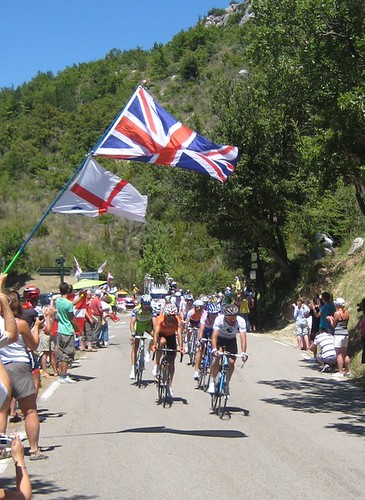
Then we waited again. Where was the Peloton? I thought that they would still be fairly close by at this point in the race, well before the epic climb to the mountain top. Ten minutes later, or so it felt, a far larger group could be seen advancing in the distance. This time I was prepared to take a video. They came around the curve equally fast. Intently focused on the road ahead, the riders looked more mechanical than human, like mighty pistons driving their bikes forward. Some teams could be seen riding together by virtue of their brightly colored shirts. Mary Ann asked what team Lance Armstrong belonged to; before I could answer, all 150 riders had passed. The whole sequence took about 25 seconds.
The train of team cars mounted with bike racks followed shortly behind. Finally, A simple banner car noting the end of the race let everyone know it was time to head back home. We had hoped for another round of freebies, but the masses descending back down to their cars let us know that there would be no more.
Letting the town clear out, we found a restaurant with a beautiful terrace, ate an afternoon snack and reflected on the event we had witnessed. The moment of exhilaration may have been fleeting but the day will stand as one of my favorites so far in France.
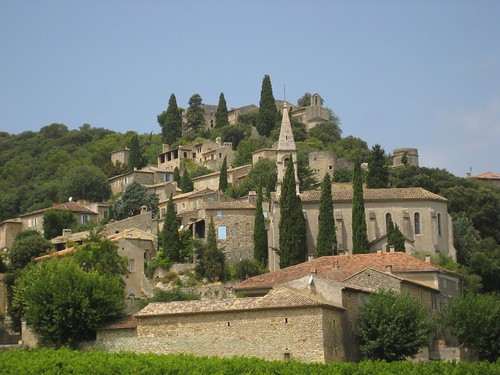
Far from being the magical times described in countless fantasy stories, the medieval era was more remarkable for the savagery displayed by roaming bands of heavily armed bandits and and equally greedy warlords. Many common people were forced off of their land and forced to live in villages for protection from bandits or for extortion by castellans. In many cases, these enclaves were built on the peaks hills. A drive through rural France reveals several of these medieval cities.
Today, these villages leverage their hilltop locations as tourist destinations. La-Roque-sur-Ceze is one of the most picturesque examples. The 3€ parking fee no doubt pays for a good deal of the city's operating expenses. The cobblestone streets are kept immaculately clean, while the homes appear to be kept in order by wealthy artisans. The peak of the hill appears to be a massive private residence - fit for a duke of course.
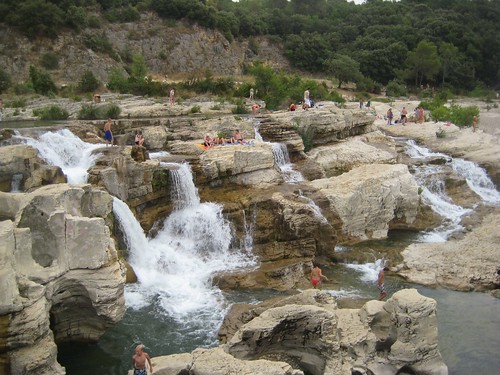
Another tourist attraction is located down the river, past the one-way-only 12th century stone bridge. Here the Cèze river descends through a series of cascades. Because of the porous bedrock, sharp chasms have been opened up by the falling water. Slightly further down river, more weathered areas of rock result in a series of hydraulic chutes and whirlpools. Although signs warn repeatedly of under-toes and unpredictable water levels, this area is a favorite of fearless kids.
On the day we arrived, the small canyon was teeming with people. Although an approved beach area is located in an official safe area of the river, the waterfalls and canyons hold the most attraction. Next time I'll be wearing my bathing suit too.
Is there an art to wine tasting? The French seem to think so. Being able to pick the right wine for the occasion is a matter of pride. Local wines, however, always seem to have the leg up on the competition.
Chusclan is home to many award-winning vintages. Most of the villages in our region belong to the Côte du Rhone AOC (Appellation d'Origine Contrôlée). This means that the types of grapes used, the aging process and even the way the grapes are grown are all closely monitored by an independent organization. In theory, this promotes consistent quality and adherence to the traditional customs of the region. For this reason, you will not find many sweet wines in this area.
Don't worry. The wines are still smooth and fruity. Rosé is a traditional specialty, but we've been very impressed with the Rouge. And that's really saying a lot coming from Mary Ann. Of course, you'll have to find your own favorites.
For that, the local wine cooperative is fully stocked and ready for tastings. The cave is the only retailer in the village that is open seven days a week and maintains consistent hours. And you can usually count on someone being able to speak near-fluent English to help you through the process. On my first visit to the Cave, with my Mother in law, we tasted four rouge and two rosé wines. The final selection in each flight was a clear winner.
We each walked away with two bottles of wine. Why stop there? The price for the quality is super cheap. Our most expensive 2004 vintage rouge titled, "Excellence" was less than 8€. The French sometimes complain about the prices, but they have no concept of what these wines are going for in the States. Then again, when wine is cheaper than water, you'll indulge enough to make up the difference.
We were lured to Alés by the promise of a large outdoor market - so noted on our trusty markets of le Gard list. Alas, we were misled. There was only a small indoor farmers market. It was far less than we have come to expect.
Having already explored the major regional cities of Orange, Nîmes and Avignon, Alés was a bit of a disappointment. As a tourist destination, it's more significant only as a launching point for trips into the Cévennes area, referring to a low mountain range in central France. We noticed a significant difference in the geography from our current home closer to the Rône.
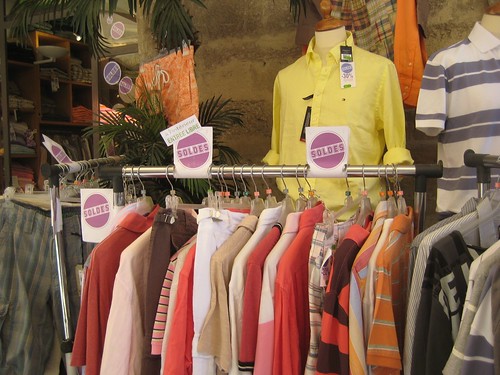
On the day we visited, the pedestrian shopping streets seemed a bit small while still less than filled. We (my mother in law and I) did manage to do quite well at the stores however. This is the season for soldes (sales in French). A set length of time in which the stores can run their best sales is dictated by the government. The trick is to find the optimum time when stores have lowered prices to their best offers but the merchandise has not been totally depleted. I left the city with three new shirts and a fall jacket for around 50€.
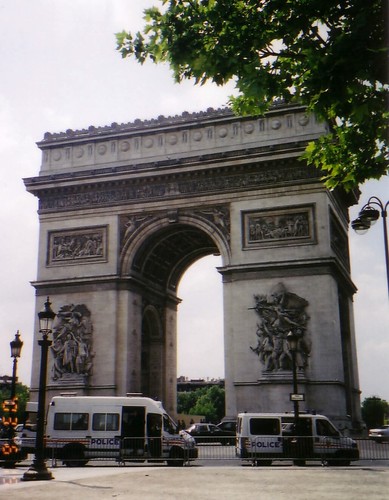
What motivates a property owner, developer or government agency to endeavor to construct a monumental structure - one that they hope will be recognized as an architectural achievement. In part, it's an exercise in egotism similar to the Pharohs' competition to build the most magnificent pyramid or Napoleon's Arc de Triomphe (itself a copy of a fairly common Roman practice). This question is uniquely addressed in The Edifice Complex, a book by Deyan Sedjic. However, immediate tangible benefit is also assumed a byproduct of such structures. The Pharohs improved their chances of ascending to the afterlife and conquerers have long needed symbols of their authority.
In modern times, the benefit is frequently as simlple as marketing. Landmark buildings can be easier to lease; they can promote tourism to a city or region; they symbolize the strength of the organization.
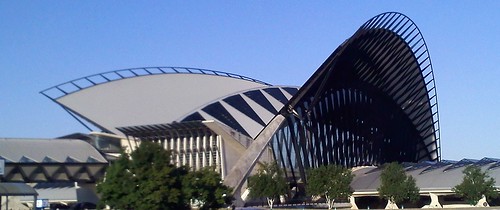
Increasingly, it seems that spectacular strutures are being designed for infrastructure projects. The crowd-pleasing aesthetic of the cable-stayed bridge has resulted in a quick embrace of this bridge type for long spans. However, this topic entered my mind as I was standing in the train station at the Lyon-St. Exupery airport. Envisioned as a gateway into France's Côte du Rhone and Alpes regions, the complex links the airport to France's high-speed (TGV) rail system.
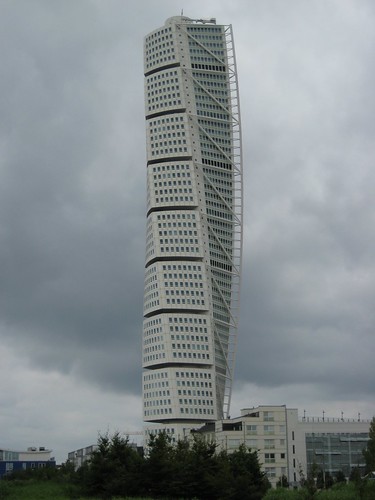
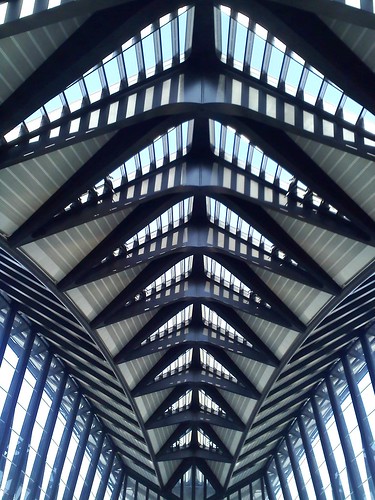
The structure was designed by Santiago Calatrava, also famous for the station hall in Lucerne, Switzerland and Turning Torso in Malmö, Sweeden. The structure features two massive fans projecting outward from the center of the structure like the wings of a bird about to take flight. Inside, the resulting structural ribs create an interesting symmetric asthetic - like you're seeing the skeletal structure from within a massive flying creature.
While the use of expressed structure clearly pleases my sense of structural beauty, the other part of my engineer's brain wonders about the cost-benefit analysis of such a structure. Clearly, additional cost was involved. The information boards in the great hall even boast that no two steel segments are identical. Could the function of linking an airport to a train station been achieved more efficiently: yes. Is the additional aesthetic effort worth it? That's a question for the ages.
While waiting in the airport for my connecting flight back to France, I spent some time in the bookstore. On long flights, I become an obsessive reader. With 12 hours to kill, there plenty of time to dig into a good book or two or three. Sometimes, you don't even need to leave the bookstore before finishing the important parts.
Such was the case, when I picked up Who Moved My Cheese by Spencer Johnson. The premise is simple. Two mice and two "little people" live in a maze. Each day the creatures go out in search of cheese. Eventually, both sets find a large store of cheese. The little people move closer to the cheese and establish a life revolving around the cheese. The mice, on the other hand, never take the cheese for granted.
One day the cheese is gone. The mice simply pick up and go out in search of more, but the people have become too attached to this place. They complain and implore the heavens to restore the cheese that had sustained them. Eventually, one of the people gathers the courage to go back out into the maze to look for more cheese. Along the way, he scribbles down some cheezy life lessons. Finally, after a period of adversity, he finds a new and more impressive store of cheese. The other person, we suspect, never does learn his lesson and wastes away his days dreaming of a life lost.
The morals are simple: do not become complacent; be proactive when change occurs; adversity provides an opportunity for growth. Basic as these principles may be, they are excellent advice for the current place and time. Many people in America had grown complacent with their lives and when the economic crisis hit home, people did not have the will to adapt. Instead, many blame outside sources, like immigrants and international competition. Many of these complaints are amplified by irresponsible media and counter-productive political messages.
Now on my second extended relocation out of the county, I feel like I've gained more of an international perspective on the economy. In order to take productive steps out of recession, I believe Americans need to understand the nature of the maze that they live in.
First, there is plenty of cheese to go around. Although there are many other people in the maze with them, they're not all adversaries. Recently I've been confounded to hear people talk so negatively about the Chinese. "Made in China" afforded middle class American access to cheap consumer products. The "cheese" of industrial jobs was not removed over night. The outsourcing of many industries was an arrangement that many were fine with, up until the market melt down. We felt that America was moving on to a more stable post-industrial economy - and so it still is.
Now is the time to embrace change. In November, a voting majority was committed to a new direction. What has happened? Now is not the time to turn our backs on green house gas pollution control. Now is not the time to delay health care reform. Like the little people in the maze, Americans are loathe to accept the very change that they ushered in (don't forget that the housing crisis is a home-grown problem). The US has the intellect and the capacity for productivity to usher in a new green industry, we just need the kick-in-the-pants that might come from cap and trade legislation.
Likewise, the US can and should reform its health care system to provide equally for all men, women and children. Is that not a moral perogitive of this country? Look internationally for effective options for reform. Health care in France and Denmark is laughably less expensive. An international insurance policy for visitors is pennies compared to a commercial US plan. It's simpler and more effective (life expectancy in France is two years longer than the US). Why is socialism a bad word? Why can't we try what works elsewhere?
The reports that I hear from the US increasingly frustrate me. I cannot even reconcile the beliefs of some friends and family. The US needs to wake up and go looking for new cheese.
![Reblog this post [with Zemanta]](http://img.zemanta.com/reblog_e.png?x-id=25404c13-9bd4-432a-bfd2-05427c24c03d)



![Reblog this post [with Zemanta]](http://img.zemanta.com/reblog_e.png?x-id=90f2995a-5d01-4467-9784-c548304822e7)
![Reblog this post [with Zemanta]](http://img.zemanta.com/reblog_e.png?x-id=b774531f-a18a-4963-8162-9d5d36a8aac7)


![Reblog this post [with Zemanta]](http://img.zemanta.com/reblog_e.png?x-id=e8af4093-17d3-4b37-9692-7ec09470e45c)
![Reblog this post [with Zemanta]](http://img.zemanta.com/reblog_e.png?x-id=ab6512fc-eaeb-4611-ace8-6dc6de220816)
![Reblog this post [with Zemanta]](http://img.zemanta.com/reblog_e.png?x-id=b7b2ea57-7e70-461e-89a8-cb4487d8d468)

![Reblog this post [with Zemanta]](http://img.zemanta.com/reblog_e.png?x-id=5c542286-eeec-4cea-9702-addee074d2ab)


