Sunday, December 27, 2009

All Wet

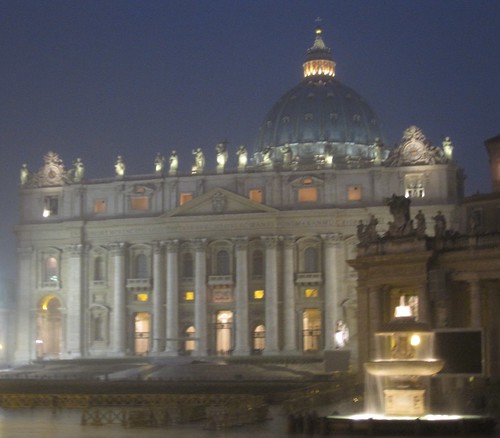
Just a few minutes after leaving the Vatican museum it started down pouring. I hid under the portico at St. Peter’s Square hoping that it would pass. Five, ten, fifteen minutes passed, but the rain was coming down as hard as ever. I was wearing a waterproof jacket. Would I be able to make it to the bus stop without getting completely soaked. I decided to make a run for it.

St. Peter's Basilica

Like an agent in one of those cheesy spy movies, I ran from street to street temporarily taking shelter under overhang. Still, I was getting pretty soaked. Eventually, I made it close enough to where I could see the busses coming and going around my corner. I ran out to the stop, just to realize that there was not cover what so ever within an easy dash of the bus. I was forced to stand in the rain for several minutes waiting for my bus to arrive. I jumped on the first one with the number I was looking for.

After getting onto the bus, I realized that it wasn’t heading in the right direction. Well, how far could a city bus go before turning around. Going to the end of the line was a lot better than standing out in the rain. Eventually, the bus did turn around, and I made it back to the Hostel.

Vatican Museum

From the top of St. Peter’s Basilica I retraced my steps back down the 400-some steps. On the way I stopped at a few of the souvenir stores, still on Vatican premises. Each of the little shops was manned by a small cadre of nuns. While each store sold pretty much the same collection of charms and crosses, the nuns were very strict about paying at the correct cash register. I assumed that they each represented different charities or orders, given turns to man the shops. I purchased a few pendants and an small plastic bottle to bring some holy water back for my grandmother.

Immediately upon crossing the street outside the Vatican, I realized that I could have purchased the very same trinkets for about half the price. Well, at least I could package my gifts in authentic Vatican paper sacks.

By the time I glanced through a few more stores, I was starving, but again caught in a touristy part of town. I did not want to pay 10 Euros for a sandwich again. Then, as I passed by one alley, I noticed dozens of students sitting on the stoop of a pizza joint. It seemed like the place to be. I found out why upon entering - pizza by the pound (actually per 100 grams). They had all your typical options: ham, onion, mushroom, and a few others. However, the pepperoni isn’t quite what we imagine in the US. I left with a full plate for a reasonable price.
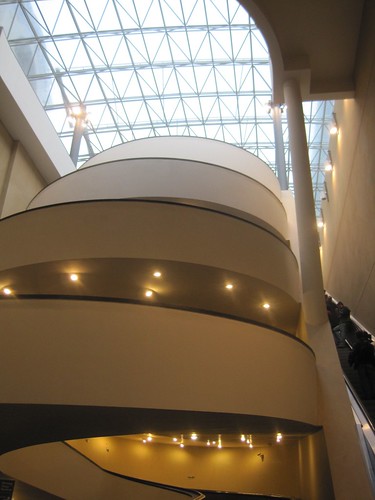
With a full stomach, I felt ready to tackle the Vatican museum and Sistine Chapel. The entrance was around the back side of the small walled city-state. A new ticketing center had been carved out inside the medieval walls. It extended upward, via a creative spiral ramp to a light-filled glass atrium. From there, visitors were directed along various paths through the historic papal residence. I opted to skip the Egyptian and Mesopotamian collection and focus on the works of the masters.
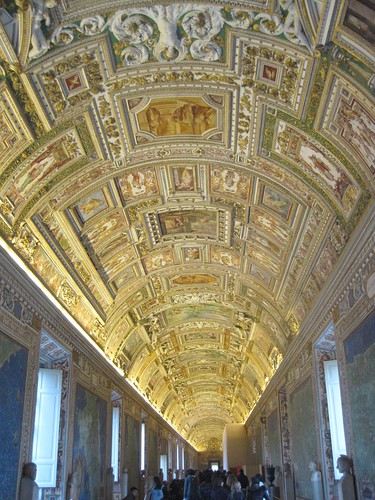
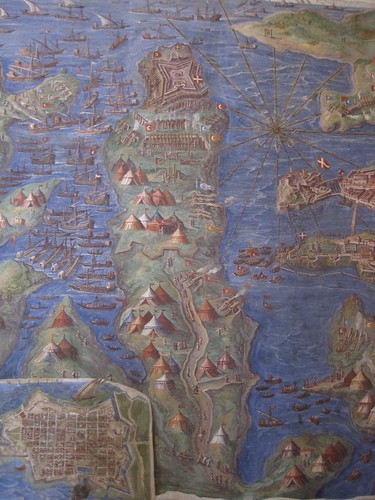
Before arriving at Michelangelo’s definitive works, guests are treated to numerous exhibitions of priceless artifacts. However, I was most impressed with the décor of the palace itself. Much of the current museum was actually the private residence and administrative halls of the Papal court. The opulently decorated rooms reminded me of several other royal palaces that I’ve seen in my travels, most notably the Louvre. My favorite was the map room. In this long hall, the Pope had commissioned murals depicting all the lands under the watchful eye of the Holy See. Some paintings even depicted naval battles. I was even able to find one map of the region where we lived in France. Unfortunately, Chusclan was not indicated by name, but Avignon and Pont-St-Esprit were noted.
Continuing on, the museum briefly opened up into an atrium containing several classical sculptures and the busts of Roman Emperors. In a museum collection, this would seem completely appropriate, but one wonders why such respectively pagan and secular images would be housed within one of the most holy sanctuaries of the Christian church. As I admired some of the sculptures, I overheard a tour guide relating these pieces to the images in Michelangelo’s characters in the Final Judgment scene. Apparently, he caused quite a stir by depicting some of the holy figures with facial structures identical to those pagan works on display in the palace grounds. Of course, Michelangelo argued that such expressions represented the highest form of artistic expression produced by man. Who were the cardinals to argue with the vision of the great classical masters?

From room to room, signs indicating the direction to the Sistine Chapel teased me forward. Since no maps of the museum were provided, I could only continue onward, taking my medicine on art history. Clearly the curators had an agenda in ushering the visitors through such a progression in styles. The final step in the journey, brought visitors to the Papal suites decorated by Raphael. Belonging to the generation immediately senior to Michelangelo, Raphael and his contemporaries paved the way for Michelangelo’s final leap forward in realistic representation and artistic interpretation. I actually preferred many of Raphael’s paintings because of their colorful vibrance and the way he captured the moment of action in his scenes. Often times the characters in the paintings are caught in between steps as their robes flow around their bodies. It’s easy to appreciate these works for their artistic qualities.

IMG_4737.JPG


I then descended a flight of stairs and continued down a non-descript narrow hallway. A simple plaque was all that identified the most famous chapel in the world. Stepping through the threshold near the front of the church, I almost collided with several tourists wandering about looking straight up at the ceiling. It took a moment for me to get my bearings within the empty space; I was hardly impressed until I too looked up. There were all the famous scenes of the bible most famously portrayed by Michelangelo. I had not realized, however, that the entire ceiling was covered in patchwork of murals. The frescoes continued half way down the side walls as well, and behind the alter, Michelangelo’s Final Judgement covered the entire wall.

It was a visual overload. The chapel was not the cohesive work of beauty that I had expected. Instead, it appeared more like an obsessive attempt to represent every significant event from holy tradition in one small chapel. Some individual works, like the depiction of God granting life to Adam by touch, was an impressive singular work. But I was otherwise too overloaded to leave with much of an appreciation for the work. Before leaving the museum for good, I returned to the chapel and spent a good ten minutes sitting and reflecting on all the images.

IMG_4746.JPG


Photos of the chapel are forbidden. That doesn’t really stop anyone. Several guards walk around the room all day just yelling at people not to take photos. Seems like a lot of hassle and disappointment for visitors just because a few dummies can’t figure out how to turn the flash off on their camera - the extreme light of some flashbulbs are known to damage sensitive paintings. I discretely snapped a few photos with my camera at chest level. They turned out pretty well.

After years of restoration work, the chapel now looks almost as good as it ever has. Centuries worth of soot were washed from the frescoes, revealing much more vibrant colors that art history scholars expected. These efforts also revealed more information about the modifications made to the paintings in renaissance times - most notably censoring the nude depictions. Shortly after Michelangelo completed his masterpiece, a new prudish Pope unapologetically went about destroying countless works of art so he wouldn’t have to look at the penises - a real conservative Christian hero.

I ended up spending the entire afternoon in the Vatican Museum. My journey in art history spanned from 3000 B.C. to present day. The Renaissance works are the most famous, but I also learned a lot about other styles. One of my favorite sections dealt with early Christian art, circa 100 A.D. These early Christians adopted a lot of customs from other ancient cultures, but added a whole new vocabulary of imagery, especially shepherds and fishermen. At the 5 hour mark, however, I couldn’t stuff anything else into my mind.
Reblog this post [with Zemanta]

Wednesday, December 23, 2009

Bad time for a snow day

“Oh no,” Mary Ann woke me up shouting her response to the weather conditions. As forecast, it had indeed snowed over night in Madrid. This is not a common occurrence in the warm weather capital. We knew that the locals would probably be freaking out. It would probably also cause problems for our eminent departure to Miami.

The snow had turned to freezing rain by the time we loaded up the car. Instead of taking Roxy on a long morning walk, we decided to get an early jump on the trip to the airport. Immediately upon making the turn around the hotel, we were confronted with gridlock. The other drivers had no idea what to do in inclement weather; they also lacked common courtesy. Cars packed into the intersection rendering the lights useless.

Stopped at one light for about 10 minutes, I was forced to take evasive maneuvers. This earned some well deserved honks and screams from an angry Spaniard, but I had no guilt. I had a flight to catch.

On the way, we skidded into a gas station to fill up and get a breakfast brioche. This was drastically complicated by a language barrier and resulted in a fruit cake. After that point, the traffic opened up and we made good time to the airport.

I dropped Mary Ann and Roxy off at the terminal and then returned the car. It turns out that we could have all stayed together, but our method worked fine anyway. We were now officially in hurry up and wait and wait and wait mode. All of the flights were well delayed, even the arrivals. It made me wonder if they had plowed the tarmac or just waited for the snow to melt. I imagined a deep queue of planes circling above.

At least we were able to wait with Roxy. We sat for about two hours before they even announced the check-in kiosk. I read a little and Mary Ann listened to music, but Roxy had the most fun pining for all the dog-lovers in the airport. One Spanish lady, who happened to speak French, described Roxy as an angel of humanity. Needless to say, she was enjoying all the attention.

Finally, the check-in location was announced and we rushed into line. At the counter, we were informed that the flight was now only running an hour late. We had no time to spare, but to begin the process of checking in Roxy, we would have to stand in another line to pay for the service. That ticket counter had it’s own hours long line. We started to get a little desperate. Finally, we were able to plead with another American at the front of the line to let us cut. After all that the teller had the gaul to ask for the payment in cash - 300 Euros, in cash! Mary Ann was incredulous. The guy, gave in and got his manual 1980s credit card swipe from the back room. Attention pickpockets, go to Barajas airport, they expect customers to make international ticket purchases in cash.

Step 2 of 3 complete, we cut back in line at the service counter and presented our paid dog travel receipt. We expressed our hurry, but the teller remained calm, explaining that the time of departure would now be 3:30. We had time. Shortly thereafter, a lady arrived to escort us and Roxy through the special security check. She took us to one of the service elevators, and we dutifully followed even though we couldn’t understand anything she said.

Communication would be important as we were ushered through the security checkpoint. I had no idea what was happening, but gathered from hand gestures to leave all of my items and walk Roxy through the metal detector. As we emerged on the other side a gaggle of airport staff were passing through the other way. I tried to get out of the way by moving into the hallway but was quickly admonished. Then I was questioned on the contents of Roxy’s water bottle. They made me open it up which broke the pressure seal. I could only hope that it stopped leaking at some point during Roxy’s adventure without us.

After that, we asked Roxy to jump into the crate. She obliged without complaint, probably getting tired from 8 straight hours without a nap. Then she was spirited away in one direction, and we were ushered back through conventional security.

Our first look at the departures board had our flight leaving at 4:00. Not long after arriving at the gate, it was pushed back to 4:20. We started boarding around 4:10. A lack of buses to take us to our plane (out on the tarmac) delayed us further, as did the route that the buses had to take which required going through two roundabouts. Seriously, there can’t be that much traffic on the tarmac.

Sometime before 5:00 we were all finally boarded and pulling away. After asking the flight crew three times, we also learned that Roxy was safely on board. Finally, we could relax… during the 10 hour flight.

Madrid

Sunday morning provided another opportunity to sleep in. Although we were still interested in exploring the city, this day would be our chance to rest before the stressful day at the airport. Roxy also appreciated the rest. Two long days of driving had really tired her out.

IMG_4983

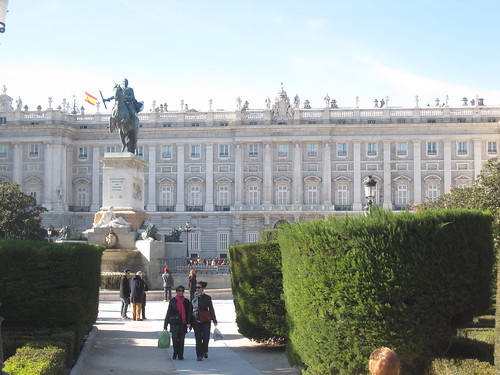
After taking care of Roxy, we again proceeded downtown. This time we started at the Royal Palace and Opera. Getting something to eat was again first on our minds. I spotted a Turkish kabob place and craved one last shwarma meal. It’s so hard to find a good place in the States.

IMG_4984

Later, we retraced our steps from the night before, cutting through the indoor market, Plaza Mayor and Puerto del Sol. Then we continued along a street chosen at random, hoping to find someplace to check our email. As luck would have it, our search again brought us to Starbucks. 45 minutes was just enough time to notify our parents of our well being and get some additional information about our upcoming flight.

IMG_4989

After backtracking to the main shopping district, we strolled along the pedestrian streets popping in and out of colorful boutiques. My favorite, based on name and selection, was called Skunkfunk. The carried lots of orange wares; my favorite. Unfortunately, all were well out of my price range. Well, maybe until I start working again...

There were lots of cool stores. One entire mall seemed to be devoted to hipster styles. Mary Ann really like all of the retro accessories and sunglasses. I tried to talk her into some goth gear. At one store, I even found a wristwatch I considered buying. Instead of actually displaying the time digitally, it contained a series of 12 dots (for the hours) and a gradually increasing bar (for minutes). Not exactly practical, but I like the idea of rethinking how we might represent time. I also liked the concept of a reverse evolution from digital to analog. However, I didn’t like the idea on the price tag.

We continued on for a bit more, eventually returning to the hotel before dinner. Roxy was up and waiting for her afternoon walk. On the way we passed by a restaurant called Vips, not sure if that was meant to be VIPs. From outward appearances, it looked to be the Spanish equivalent of Denny’s. We couldn’t pass up that opportunity. The food was as expected, but at least it was a comfortable setting, and it had Wifi.

IMG_4995

After dinner, we decided to celebrate our last night in Spain with some personally sized champagne bottles. Serious, they were like wine coolers, but with bad sparkling wine instead. I drank enough to thoroughly dehydrate myself in advance of the ten hour plane ride coming the next day. It seemed like a fitting end to our high class/ low cost trip through Iberia… or maybe that was the other way around.
Reblog this post [with Zemanta]

Over the mountains (to Madrid)

We slept well in Barcelona and even convinced Roxy to let us sleep in a bit. At 10:00, there was still a complimentary breakfast bar waiting in the lobby. The andouille sausage and cold Spanish omelets were a little unexpected, but sufficient to get us going. It turned out that the cab ride the night before wasn’t without some benefit; it gave me the chance to get my bearings. We easily found the route back to the highway and started the long drive to Madrid.

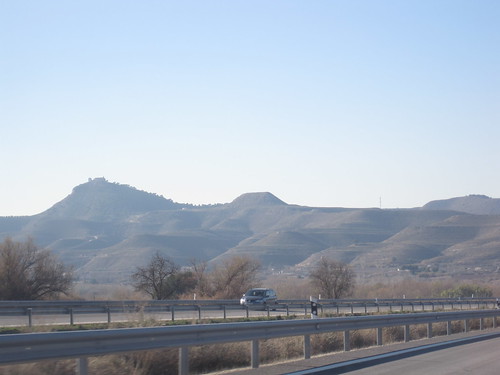
After leaving Barcelona, we climbed the foothills of the Pyrennes. The Catalan countryside was more what I expected of Spain than the modern metropolis of Barcelona. Quaint villages were positioned on rocky hills. Fruit and nut trees and vineyards stretched out through the valleys.

Quickly, though, the landscape became more arid and the population density dropped dramatically. Along desolate mountain ridges lonely modern windmills stood sentinel. I imagined the old Don Quixote sage with the new modern power generators. How might he have reacted to blades the size of a 747. And yet, at such distance, they were just tiny reminders that we hadn’t completely left civilization. For many hours, there was almost no development to speak of. We followed signs to Zaragosa, a town apparently large enough to host a top league soccer team.

IMG_4973

Without much warning, the arid landscape gave way to cityscape. All of the buildings seemed brand new. I had to imagine that Zaragosa was a planned city, with incentives to bring residents into the uninhabited central region of the country. That was, after all, the idea behind the settling of Madrid.

The drive was easy enough, good weather and light traffic conditions. Undulating hills and curious rock formations provided just enough interest to keep me alert. Mary Ann noticed that many of the hills seemed to have lost their tops. Curious isn’t it that some Spaniard from this region might have been in the armies that first encountered the flat topped pyramids of the Aztecs. I surmised that many of these hills might have been worked over time for settlements or agriculture.

IMG_4970

Our approach into Madrid was almost as sudden as driving through the other small cities in central Spain. I suppose that we skirted much of suburbia by taking the toll road bypass. Again, our directions were golden until up to the last two miles. A missed exit here and an unmarked street there, and we were again orienteering on instinct. This time the saving grace was the map Mary Ann printed with directions to the airport for the next day. We eventually found the hotel and street parking to boot.

The Travelodge wasn’t quite as nice, but it met our criteria: clean, quite, cheap, and they accepted pets. Roxy was happy to find a dog park near by, and we again expected to be near the city Metro system. We only got slightly lost on our walk to the station.

Hoping for a deal, we opted for the one day tourist pass Metro ticket assuming the followed the same 24 hour rule as Chicago. Not so, we learned the following day. On the trip, we were doing our part supporting public transportation by paying unnecessary fees. Beyond the unfair calendar-day, the subway was really nice. To get to the center of town, Puerto del Sol, we had to make a few connections. Pretty easy to do following the color code and end-station direction rules.

Emerging from the underground station into the main square, we were engulfed in a sea of people. We could not believe how many people were out and about. But the odd thing was that there didn’t seem to be any focus of the madness. There was no real event taking place. That didn’t stop the crowds from taking to the streets. All around traffic was closed and people of all ages wandered around, grabbing snacks at the cafeteria-style restaurants and doing late-evening shopping.

IMG_4979

The only real pattern we could discern among the crowds was the habit of wearing crazy hats. At first, the Rudolf caps seemed cute, but then there were also giant afros, wildly colored wigs and springy holiday top hats. We even passed a stand selling Christmas masks. Nothing says, “happy holidays,” like creepy Barack and Michelle Obama masks. If you’re Spanish and reading this blog, please explain this tradition.

We eventually pushed our way through the crowds to the Plaza Mayor. There we encountered a traditional holiday market. Unfortunately, they weren’t serving any local fare. This was somewhat of a disappointment, because all of the restaurants in the area were packed. We wandered around a bit more, before our standards began falling again. I even considered going to Burger King.

IMG_4982

Finally, we stumbled a suitable establishment. It was a little strange that they were nearly empty, despite the mass of crowds. Still, it offered a chance to sit down and enjoy some local fare, namely a plate of ham varieties and patatas bravas. These fried potatoes in spicy sauce are probably my favorite Spanish dish. Mary Ann judged the meal and the sangria more satisfying that our previous night’s fare. And we even made it back to the hotel via the subway too. We were starting to get the hang of travel in Spain.
Reblog this post [with Zemanta]

First stop: Barcelona

Early Friday morning, we drove back down to Avignon to pick up the new, larger rental car for the trip to Madrid. Mary Ann woke up at 6, I slept another hour while she got ready.

While she dropped off the old car, I went across the street to Avis to begin the process for our new vehicle. Everything seemed to going well, until we were notified that the uncovered damage limits extended up to 15,000 Euros. Holy crap! Um, yeah, we’ll take the additional insurance. It was expensive, but probably worth it to avoid one less bit of stress on the way back.

We were told that we were getting a Picasso. I hoped it would be big enough, didn’t think he was famous for oversized works. It turned out to be what goes for a mini-van in France, mono space. The trunk was huge. Compared to the small compact cars we’d been driving for the past six months, it really felt like a semi. The ride was smooth though, and the diesel engine had plenty of pickup. The Picasso would be satisfactory.

I dropped Mary Ann off at work and returned home to finish the packing. First, I had to complete the digital packing, transferring all of my files off the MacBook that would stay in France with Mary Ann. Then, I went through the refrigerator and cleaned out all of the perishable food-stuffs. By the time I washed the dishes, cleaned off the counter and threw every last thing in the bags it was already 2:00. Packing went quickly - plenty of room in the Picasso. Lastly, I took Roxy up for one final visit with the Berards. A half hour later, we on our way to pick up Mary Ann from work.

Finally, while sitting in the parking lot and waiting for Mary Ann to join us, I enjoyed my first moment of excitement about the journey ahead. Up until then, we had been stressing about all the details. The time for saying goodbye to people, to Chusclan, to France… was over. We pulled onto the auto route and followed the signs to Barcelona.

With the exception of the setting sun in my eyes for two-and-a-half hours, the drive went smoothly until we reached Barcelona. Mary Ann had meticulously printed out all the Mapquest directions for the trip, but as usual, it was insufficient in the city. We tried to follow a half-dozen turns, winding through a maze of highway interchanges. Our undoing was to look for an unmarked street off the main drag.

Fortunately, the hotel reservation had a map included. Judging our location by proximity to one of the main highways into town and the name of the city in which we were staying, we course corrected back in the general direction. Each street seemed to throw us deeper into the maze. At last we found street signs to the hotel. It was difficult enough following these, however. By the time we pulled up to the Hotel, I was thoroughly disoriented. I had no idea where we were, but at least we were there.

Roxy was happy to get out of the car and check out the surroundings while Mary Ann checked in. The Sercotel Ciutat de Montcada hotel was nice and modern. It sported wooden floors and fancy bathroom fixtures. But we didn’t stick around the room. Having pressed on without dinner, during the five hour drive, we were starving for some tapas and sangria.

We learned from the concierge that the train into the city was just blocks away. It was easy to find, down the hill and through a shady undeveloped brown lot. I got the impression that our hotel and the connected mini-mall was a attempt to gentrify the neighborhood. Anyway, if the trains ran, it wouldn’t matter. We found a 20-something girl to tell us which side of the tracks to stand on and soon enough we were racing into town - quite a bit farther than expected.

The train conveniently pulled into a station at the top of La Rambla, the main dining and shopping street of town. We passed by the usual tourist stands and street performers looking for the perfect tapas place. I had one particular street in mind, but at night I wasn’t able find it, as we wandered substantially longer than our stomachs would allow. Finally, we settled for a bar that seemed not-too-shady. We ordered the house special tapas and a ½ order of sangria. What we got was a mug of sangria with two ridiculously long neon straws and the plates that no one else wanted. It was enough food to satisfy our appetite, but not much of a culinary experience. The meal was made slightly better when we discovered that we were sitting next to two current University of Michigan grads - small world indeed.

After dinner, I was still looking for something to quench my thirst and keep me warm. We happened to be in Barcelona on one of the coldest nights of the year. Looking for a sure thing, we got two chai tea lattes from Starbucks. Old habits die hard (even if they’re put on hold for 6 months). It was quite enjoyable to walk down to the pier and back reminiscing about the past year and looking forward to the holiday. As we approached the train station at midnight, we judged the day successful.

After buying our ticket and walking down to the platform, we were approached by a station employee. He said that the line was no longer running. What?! We had checked the times before making our way into town; there was a midnight train. Later we realized that the time was highlighted in yellow, whatever that meant. About a half-dozen other people were also turned away before we exited the platform. Well… now what? We had to cab it back to the hotel. Fortunately, Mary Ann had kept the address of the hotel in her purse - nice thinking!

The drive back seemed to take a really long time. Of course, the thought crossed our minds that the cabbie didn’t know where to go and was just taking us for a ride. His onboard GPS gave me a little more confidence, even if we could not communicate very well. 25 euros latter, we finally made it back to the hotel - quite an expensive ride given the exchange rate. At least we would have a nice night’s rest before taking up the journey again in the morning.

Final Goodbyes

The day before our departure, the Berards demanded one last chance to play with Roxy. They gushed about her manners and playfulness. I got the feeling that they would definitely miss her more than me. Roxy, I’m sure, will miss them tremendously as well. She may never again have her own private garden, and there won’t be opportunities to take long midday hikes in Chicago.

While up in their place, Roxy discovered Madame’s rabbit. It was dark, so at first Roxy could only smell some animal. When she approached the cage, the rabbit jumped and so did Roxy. She didn’t quite know what to make of the small animal. I didn’t want to find out if Roxy equated it with an after dinner snack and shoed her back the the Berards.

Andre liked having a companion while working out in the garden. He got down on all fours and rough-housed with Roxy for a bit. It was pretty funny to the 60-year-old man doing his animal impressions. Roxy allowed him to man-handle her feet and grab her canines. It’s amazing that she knows just the right amount of pressure to apply so not to hurt someone. Of course, she could have taken Andre’s finger as a souvenir.

As we left, they pleaded for one more opportunity to say goodbye to Roxy right as before we left for good.
 
Creative Commons License
This work by Ken Maschke is licensed under a Creative Commons Attribution-Share Alike 3.0 United States License.