Monday, October 12, 2009

Celebrating Wine (day 2)

Our antique car disaster was not enough to keep us from day two of the biggest party of the year - in Chusclan. Again, our landlords insisted that we arrive in town early to see all the dancing and singing and Provencal merry-making. To our surprise, Chusclan was even busier than the day before. And even more people were wearing their old-time costumes. We had elected to go as typical tourists... in case we were stranded somewhere again.

Our first stop was at the accueil (welcome) table to buy our wine tasting glasses. For just 3.50€ we could enjoy unlimited degustation (tasting). The best, and classiest, part of the tradition is that the glasses are mounted on strings so you can wear it around your neck all day. That way you never lose any time between rounds searching for your glass.

Madame Bérard again showed us around town, making a point of directing us to the very best wine tasting stands. I think we visited the Champaign stand three times. In all there were about a half dozen different wine cooperatives represented around town. Of course we had to try them all. Now with three months of wine tasting experience, we really felt like pros swirling, slurping and making funny faces. As expected, the local wine was the best - I mean, why would you invite someone with better goods to your wine party?

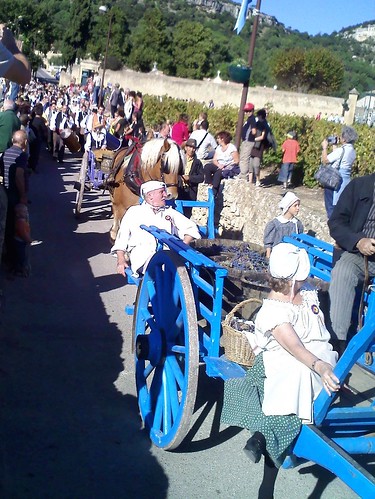
All day, local residents played the part of peasants from the 1800s. I was most impressed by the guys shoeing the horses. I was a little surprised that the horses were so accommodating, allowing the smith to manhandle is massive hooves. Nearby, a faux-nun pretended to scold school children, women washed the same white linens for hours and an accordion player flipped through this collection of classic tunes.

Meanwhile a drum and whistle band was supplying the music for a troupe of dancers. Professional might have been too strong a word to describe both groups, but they certainly held the tourists' attention. The most impressive dance was performed around a pole with colored streamers flowing from the top. Each dancer grabbed a streamer and followed joined in dancing around the pole. The choreographed movements resulted in a colorful braiding - pole dancing a la 1830.

Braiding Pole Dancers

Around 3:00 the mayor announced the grape harvest. The costumed residents look their places in a parade of donkeys and dancers and processed out of town and to the nearest vineyard. The mob of tourists followed. Reaching the end of the field, the mob disbursed among the vines and began collecting grapes. Large wooden barrels were filled and mounted on the mules. The procession then returned to town to celebrate the pressing of the grapes.

Unfortunately, this local celebration did not include an grape stomping. However, the freshly squeezed grape juice was collected in a large cask and served to the brave. It actually tasted pretty good - very sweet, not much different than your highly processed supermarket variety.

See more photos of the Chusclan Vendanges de L'Histoire on my Flickr page.

Reblog this post [with Zemanta]

Sunday, October 11, 2009

Celebrating Chusclanaise History (day 1)

This weekend was the 11th annual Vendanges de l'Histoire in Chusclan. The autumn festival celebrates the local traditional culture associated with grape faming and provides a really good excuse to drink lots of the products of that labor. Many of the event's attractions reminded me of home: the old tractors, a petting zoo and antique cars on parade.

Our landlords were pretty committed to ensuring that we received the complete Chusclanaise experience. They reserved diner for us on both days of the party and hooked us up with a classic car ride. But most importantly, madame provided Mary Ann with an authentic provencal costume. True to the local flair, the outfit included a lavender skirt, shawl, apron and bonnet. I attempted to join in the spirit of the peasantry by wearing a knit shirt and a straw hat. I'm sure we made quite the couple.

sepia

We joined the festivities shortly before lunch. It was incredible to see so many people in the small town. For a moment we couldn't figure out how so many shops and wine tasting places managed to open over night. Then Mary Ann realized that these merchants had just set up shop in people's garages. Apparently, the city itself joined in the costuming craze.

Finally meeting up with our landlords in the place de la Mairie (city hall), we decided to enjoy an apertif and then take an early lunch (12:30). A makeshift guinguette was constructed in the public boules courts, where they were serving heaping portions of paella. This traditionally Spanish dish included a menagerie of meats and seafood mixed into spiced rice. As usual, it was better not to ask what you were eating, but just enjoy all the flavors. The second course was a plate of two giant slices of cheese. Together, Mary Ann and I finished about half of one serving. A meal, of course, would not be complete without desert (some type of apple tart) and coffee.

Completely stuffed, we waddled over to the antique cars that would be taking us on a 1 1/2 hour tour of the countryside. André had chosen for himself a 1971 French muscle car. It was unique in that the rear two tires would set at an angle to improve handling performance. As they fired up the engines, it certainly sounded like a fast sports car. Madame, Mary Ann and I, on the other hand, were seated in a 1937 Peugeot with a top speed of about 35 km/hr. We were counting on a more scenic trip.

We proceeded along the route that we typically take when going to points North. It's my favorite road in France because of the tight turns and minimal traffic. Not yet featuring any automated radar speed traps, it's a great place to channel your inner formula one driver. However, it was nice to travel at slower speeds, as I had the chance to see for the first time a chateau on the opposite bank of the Rhône. Our path took us through Pont St. Esprit and then west along a rural road that was completely new to me.

And that's when Madame Bérard told the driver that it felt like her shoes were melting from the heat emanating from the car. A few moments later, the engine began sputtering, and then we were stalled. The situation wasn't make very clear by the driver, but we soon realized that the vehicle had overheated. We were stranded. Fortunately, another of the antique drivers and his passengers were kind enough to wait with us, while the car was being worked on.

broke down

It turns out that some part of the engine had actually melted - something to do with a spool or a coil. Engine mechanics is not my specialty, but I think it had something to do with the electrical system. The driver tried repeatedly to get the engine to turn over, after making a series of small adjustments. Finally, he gave up and phoned a friend to bring over the necessary parts.

Now, keep in mind that we were all dressed in traditional garb. This is not normal attire, even for the French. We received quite a few odd glances from passersby. Realizing that we were American's someone pointed out that this wasn't a very good advertisement for French engineering. I was thinking, "if this was typical of 1930s French machinery, then it helps explain the success of the German blitzkrieg."

Meanwhile, André had returned to Chusclan in his sports car and realized that we were well behind schedule. He and the driver turned around and backtracked to our location. All the while, we waited. When our driver finally heard from his friend, it was to say that there had been some problem getting to our location. We waited some more. André arrived in his blue sports car, but with only two seats, we were still out of luck.

Needless to say, when the mystery part finally arrived, it didn't work. We ended up retracing our path back to Chusclan in a ten year old Citroen sedan - not exactly high style. How reliable is a 75-year old car? I wonder how reliable it ever was. I suppose that we had the most authentic experience, but I'll be content from now on to travel in modern comfort.

Reblog this post [with Zemanta]

Wednesday, October 7, 2009

Running of the Bulls

Pamplona isn't the only place where you can take part in the running of the bulls. The Camargue has it's own tradition of bull running. We were lucky to catch a glimpse at le Grau de Roi.

While the camarguaise bulls are slightly smaller than your average breed, I still wouldn't want to be in it's path going full speed for any amount of time. Apparently, French teens do not share that sense of self preservation. Instead, I've learned that your goal should be to stand in the way as long as possible.

picture0055

Now I suppose that they're given some measure of confidence by the presence of the Gardienne, Camargue cowboys. A top their horses and armed with long spear-ended poles, they attempt to guide the bull down the street. So the fearless spectators must also avoid being trampled by the large quarter horses.

picture0056

Still seems pretty safe, right? Well, if you're lucky, the gardienne will try to head off the taureau so that it must come to a stop. That's your signal to run into the street grab onto the half tonne bull and attempt to wrestle it to the ground. It usually helps to get about a half dozen pre-teens to jump into the fray, and do not forget the one hopeless soul who will grab the tail to slow ithe bull down. Don't worry, they almost always put a cap on the horns to prevent gorging.
Reblog this post [with Zemanta]

Course Camarguaise

A trip to the Camargue would not be complete without an evening in the arena viewing the course camarguaise. This local type of bull-fight pits man against beast in an athletic show of speed and agility. The bull is the protagonist. Taureaus are rated throughout the season based on their performances. Based on this ranking, they receive WWF-like billing when they enter the ring. Unlike in the Spanish Corrida, the Camarguaise bulls are not harmed during the course. The band of a dozen or so tourneur, on the other hand, are applauded most vigorously when on the receiving end of the bull's charge.

picture0087

The primary objective of the game is to remove from the taureaus one of three object attached dangerously to their body. The ficelle strings tied around the bull horns are the most difficult to remove. Tourneurs must make strafing runs past the taureau attempting to cut loose the ficelle with a special claw-like device. When working as a team, they are most successful when running from either side of the cow in rapid succession.

picture0088

However, the taureaus are smart and always unpredictable. The bull-fighters frequently must jump out of the ring to safety. Because of the height of the ring-side boards, a small step is provided about a foot off the ground. The form of the dive seems awkward and is only successful if the tourneur is able to catch the metal railing along the first row of spectators. Amateur bull-fighters are probably at greater risk to injury attempting this "jump for safety" than inside the ring with the bull.

picture0086

We happened to attend one of the season finales. This meant that only the best taureaus were in action and the stakes were highest. As the course progresses, the men are offered increasing payouts for successfully removing the ficelle. The announcer rattles off a string of dollar amounts provided by sponsors. This auctioneer-like rattle is incredibly annoying and is only disrupted on the occasion of some near catastrophe in the ring. I would have preferred some ring-side advertising and the soundtrack from Carmen.

In the end one the taurneur was named league champion and the bulls were free to return to their grazing until next season.
Reblog this post [with Zemanta]

Les Salins de Camargue

It's said that the Roman engineer Peccius was the first to organize the salt production efforts in the Camargue. The natural salt marshes and higher-than-normal natural salt content make the region an obvious place to harvest sea salt. In Aigues-Mortes, 500,000 tons of salt are distributed annually. While some of the process occurs naturally, capturing the quantities of salt demanded by market requires an engineered process.

First the salt is collected into vast evaporation pools. More than 45 million cubic meters of sea water must be pumped during the month of march. Throughout the spring, the evaporation process increases the concentration of salt 9-fold to 260 grams per liter. By mid-summer a thick cake begins to form on the surface of the water. The concentrated brine can grow to 20 cm thick, 9 cm of which is harvested as sea salt. The top of the cake takes on a bright red hue due to the presence of a special kind of algae which turns brighter as the salt concentration increases. Some of the algae and waste sediment can be collected and used as fertilizer, while lower quality salt is sold for road de-icing.

In September, the salt is harvested. Quality control measures ensure that the product is 99.5% pure sodium-chloride. Some salt is shipped on flat bottom barges along the shallow canals to the port, while another portion is loaded onto rail cars and sent in land. Several special bridges and conveyor systems are placed in service specifically for the once-a-year collection.

Three major brands are harvested in the Camargue, including Le Saunier de Camargue and La Baleine. Ironically, they are all owned by the same parent company. Many of these brands are widely available in the US.

Having harvested salt from these marshes for over a thousand years, the Camargue salt farmers have struck a symbiotic balance with nature. While many industrial processes pose a threat to the local ecosystem, salt farming in the Aigue-Mortes salt marsh has actually demanded preservation of the indigenous wetlands. Of course, the salt companies probably exaggerate the extent of this success. Nevertheless, it is a model living sustainably with nature.
Reblog this post [with Zemanta]

Port Camargue

Can you name the largest recreational port in France? Nice? Nope. Marseillies? Maybe not. The title goes to Port Camargue. Maybe only 30,000 Frechmen know the answer, but by docking their boats in the creatively engineered harbor, they set the record.

The port is located just outside le-Grau-de-roi. While the city may have historic roots tracing back to Roman times, the Port Camargue is decidedly modern. From above, the marina layout is similar to the pronged islands being built in Dubai. The land has been sculpted to maximize the amount of water-side property and boat anchorage. For those not quite wealthy enough to park their boat within feet of their vacation home, dozens of jetties are available for docking at only mostly exorbitant prices.

picture0084

We had an excellent view of the harbor from our hotel, Spinaker. It was located amid several docks. It would be a great place to stay, if you had just sailed into town. Morning walks with Roxy were quite a bit more enjoyable while checking out all of the sailboats and yachts. My favorite are the catamarans. Maybe someday I'll be able to dock my own in Port Camargue.
Reblog this post [with Zemanta]

Le Grau de Roi

On his way out to sea from Aigues Mortes, Saint Louis would have first had to navigate a narrow inland channel, called a grau. Along the way, his view would probably have been similar to the one that modern visitors enjoy. Riverside reeds provide a habitat for feeding flamingos. Camargue bulls graze on dry plains between the marshes. Farmers store their sea-salt harvest in tall mounds. With the exception of some sprawling harbor communities near the city, local managers have done a good job of preserving the unique natural habitat.

picture0060

Finally the waterway, cuts through le Grau de Roi, so named in honor of Saint Louis’ first passage, and spills into the Mediterranean. Today, the city is a major tourist destination. The canal through town is lined with restaurants, offering the day’s freshest catch. Further inland, the city streets provide a menagerie of traditional tourist trinkets and apparel. The rows of Slushie machines reminded me of Bourbon street.

picture0029

An expansive sandy beach stretches for miles along the coast. However, except for the ocean channels dug to allow the fishing fleet to exit to the sea, the water level is low. At low tide, it’s possible to walk all the way out to the breakwaters, several hundred meters out from the boardwalk. Developers have seized on the opportunity to build along the beach and erected all sorts of odd pyramid and wave-form shaped time-share buildings.

Fortunately, we visited on an off-season weekend. This allowed us to stay in an excellent high-end hotel (3 Logis lamps!). But, most importantly, it meant that the traffic and crowds were manageable. Given the vast numbers of condos, I could not imagine visiting in season.
Reblog this post [with Zemanta]
 
Creative Commons License
This work by Ken Maschke is licensed under a Creative Commons Attribution-Share Alike 3.0 United States License.