Showing posts with label Orange. Show all posts

Thursday, August 6, 2009

Chorégies d'Orange

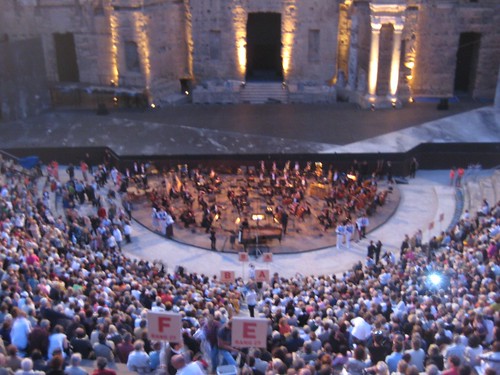
Earlier this week, Mary Ann and I returned to the Roman theater in Orange to see a musical performance by the French National Orchestra. We heard Moussorgski's Pictures at an Exposition, a Rachmaninov piano concerto and a selection from Tchaikovski's 1812 overture. It's hard to say what was more impressive, the theater or the music.

I'm continually amazed that these Roman edifices are still used for their original purposes 2000 years later. So, I thought I would try to put myself in the position of a Roman attending one of the earliest performances at the Theatre d'Orange.

-- begin dream sequence --

On a breezy summer day in A.D. 60, a Roman merchant was hastily deconstructing his vegetable stall in the city of Orange. It had been a busy day at the market and his mind was elsewhere. Today would be his first opportunity to catch a play at the recently opened theater.

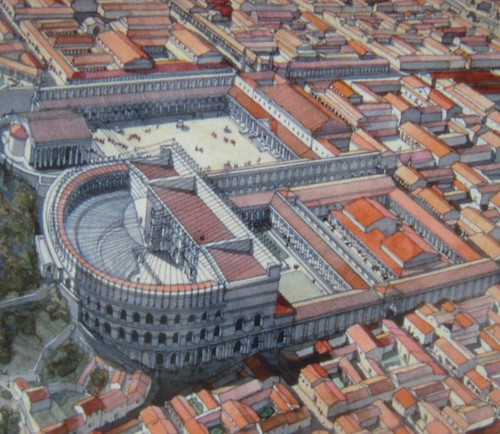
It was the talk of the town. Even the hard-to-impress Gauls had described the edifice with a magical reverence. The theater dwarfed the other buildings in town. It so loomed over the adjacent temple that some of the lower castes whispered that the Cesar must be more powerful than the gods. Who else could command the hillside to spew forth rock and stone in such order to create the massive stage wall?

The merchant simply couldn't miss this opportunity to marvel from within the theater walls. He was looking toward the opportunity to mingle with his peers and possibly hurl an insult or two at the senators seated in the front rows. The theater was known to be the best venue for judging your place in society. There were no entrance fees for citizens of Orange, but seating was strictly enforced by class. However, all were welcome at the theater. Women could sit with their husbands. And even the slaves could peer into the theater from the ridge just above the last formal seating rows.

Getting to your seat in time meant leaving the house early. When the final call to start the program sounded, the merchant did not want to be left queuing outside. As it was, he would have a difficult time getting around town, since the streets around the theater would be restricted to theater-goers. If he was early, on the other hand, there would be an opportunity to relax and have a drink at one of the many cafés in the area.

Half an hour before the show, the merchant and his wife arrived at the gates of the theater. Not yet accomplished enough to warrant a seat in the lower bowl, they ascended the steps to the upper balconies. The steps were steep, slowing older patrons - some had to rest half way up. Bounding up the final step and entering through the vomitorium the merchant was rewarded with a breathtaking view.

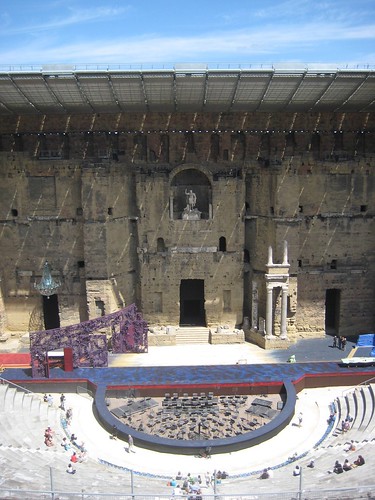
Gazing into the stands from across the stage was the visage of the Emperor. His statue clearly signaled that this theater was a product of Rome. Flanking the doppelganger to each side were elaborate colonnades and false balconies, comprising the stage wall. The two front corners of the theater were stabilized by masonry towers. The merchant could imagine the actors preparing for the show in these wings. Over head, long cloth banners spanned the length of the theater providing welcome shade from the hot sun.

To be continued... (maybe)

View more of my photos of Orange at flickr.
Reblog this post [with Zemanta]

Friday, July 10, 2009

Orange Theater

The city of Orange is home to the most complete Roman theater in all of Europe. In fact, only two other Roman theaters in the world can boast of having a similarly preserved stage wall – the backdrop for any production performed on stage. The theater of Orange miraculously avoided destruction by a series of foes, including: the Christians who frequently destroyed any symbol of Roman paganism, the Visegoths rampaging through the Western Empire, and Mother Nature.

The condition of the theater today is the result of continuous renovation that began in the late 19th century. The latest addition is a modern roof over the stage. In antiquity a wooden roof would have cantilevered over the stage. Long sheets of linen would also be draped across the entire seating semi-circle. The restoration efforts attempt to recreate for theater patrons the experience shared by the Romans.

The events currently hosted by the theater differ significantly from those that would have been most popular during the golden years of the Empire. Symphonies and Operas now rule the theater, but mime would have been most prevalent in the second century A.D. Contrary to our definition of mime, some dialogue was permitted, but the shows were mostly about spectacle: elaborate costumes, “special effects,” action and slapstick comedy. The shows became increasingly outrageous until degrading into pornography. At which point, the Emperor Justinian, whose wife had been an actress, banned mime productions.

The degradation of theater morality is especially ironic, because early Roman leaders were fearful that institutionalized leisure would make the populous lazy and unruly. They partially attributed the Greek’s love of theater to the downfall of Hellenic Empire. For several centuries, Roman theater productions were only permitted to be performed on temporary stages with no seating for guests.

Eventually, the Roman Emperors realized that theater provided a means of indoctrinating conquered peoples into Roman culture and distracting them from thoughts of revolt. It’s highly symbolic that a sculpture of the Emperor looms large in a niche directly over the center of the stage. Within 100 years of the defeat of the Gauls, the residents of Orange had almost entirely accepted Roman language, culture and governance.

The Roman culture and technical achievements would have been highly attractive to many indigenous populations. That is in part why the Pax Romana lasted as long as it did. It also gives some historic perspective to the fear of native cultures in the US and elsewhere that the American Consumer culture will overwhelm local customs. It’s striking, and a bit scary, how many American brands are available in France.

McDonald’s may have kicked off the trend; now, even Starbucks is available. Supermarchés, like Meijers, are springing up outside cities. The French even had to pass a law requiring radio stations to play at least 40% French language music (the balance is typically English). And for the first time, we’ve seen obese French. Locally, this is blamed on the new availability of processed foods so common in American diets.

Once again, it’s fascinating to me how ahead of their time the Roman’s were. The technical achievement of constructing the Theater of Orange is no less impressive than today’s architectural gems. And the cultural warfare conducted through these edifices is eerily similar to America’s goal to win the hearts and minds of the people in whose countries we wage war. The old adage that history repeats itself rings true after a visit to Orange’s ancient theater.

Reblog this post [with Zemanta]
 
Creative Commons License
This work by Ken Maschke is licensed under a Creative Commons Attribution-Share Alike 3.0 United States License.