
Vespasian didn’t care much for politics. He earned his fame with victories in the war to reclaim Judea for the Empire. State functions bored him and the ramblings of the Senate only complicated his battlefield strategies. When a civil war broke out in Rome, in the wake of the Nero‘s tyrannical reign, Vespasian returned from the front lines, and with the authority of his armies established himself as the new ruler. His son Titus was left to finish the job in Jerusalem.
To solidify his position as Emperor, Vespasian needed to gain the popular support of the people of Rome. One of his first acts was to return to the public much of the space acquired by Nero for his self-aggrandizing villa, called the Domus Aurea. Legend has it that a bronze colossus in Nero’s image stood at the entrance to the private gardens and porticos. This is where Vespasian planned to locate his stone amphitheater - henceforth it became known as the Colosseum.
Construction of the massive edifice (615 ft long by 510 ft wide by 160 ft tall) would have been extremely costly, even for the Roman Empire. However, shortly after Vespasian’s ascension to ruler, Titus completed his middle-eastern campaign and arrived Rome with cartloads of treasure, possibly from the destroyed Temple of Solomon. Titus’ Arch of Triumph commemorates his return with riches, but experts disagree about the extent to which those valuables could have financed the construction of the Colosseum. In a romantically historical sense, it’s intriguing to link these major structures and events of history together in such a way. In fact, the legend continues, since it has been recorded that stone mined from the ruins of the Colosseum were used in the construction of St. Peter’s Basilica in the Vatican.
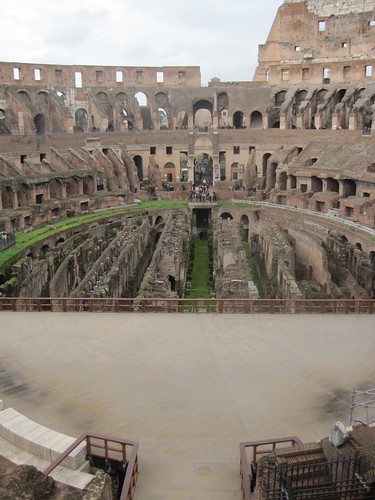 The Colosseum was completed in 80 AD under the rule of Titus. Amazingly, it only took 10 years to construct. Upon completion about 50,000 spectators were able to witness gladiatorial contests, wild beast hunts and possibly even naval battle re-enactments. The elaborate staging was made possible by a complex under-stage structure complete with mechanical elevators, trap doors, underground tunnels and an potentially massive piping system capable of flooding and draining the lower bowl.

In many ways, the architecture of the Colosseum is still very familiar to us today. A system of ramps allowed the citizens to proceed directly to the correct concourse. Seating was assigned by social status, but at least admission was free for all those permitted to attend the events. On the concourses, vendors would sell souvenirs and food. The spectators were even known to play betting games and make wagers on the activity below. Gambling was controlled by the State and sometimes banned, depending on the ideology of the rulers.
 Even the structural elements of the Colosseum are employed to this day in stadium design. We’re very familiar with the series of concentric seating rings. As in today’s construction, these seating sections were supported by evenly spaced rakers oriented perpendicular to the rows of seating. Today it might be more common to use a series of reinforced concrete or steel beams for this function, but the Romans managed just fine with masonry arches. Between the rakers, they used continuous vaulted arches, inclined to provide “stadium seating.” It appears that these arches were formed with a clay brick and then topped with a low strength concrete fill to level out the seating surface. Similar technology was still being widely employed in steel building construction well into the 20th century.

As brilliant as the engineering of the Colosseum might seem, the techniques employed were well practiced by centuries of previous Roman construction. The truly impressive feat is in the organization of the construction and the collaboration between experts. No documents explicitly state the members of the design team, but we can assume, based on the speed of construction and the success of the design, that a division of labor similar to modern project teams was in use. In the centuries following, master builders would receive the credit for masterminding architectural feats, but back in Roman times we can suspect deeper specialization leading to more incredible structures.
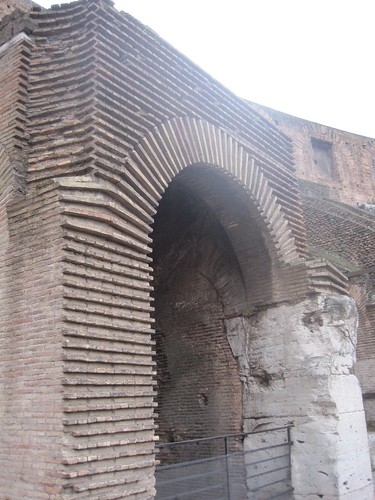 However, the Colosseum was lacking in one design criteria. A major earthquake in 443 AD caused damage requiring fairly substantial renovation. And in 1349 another quake caused the collapse of the outer South ring. The damage can in part be blamed on the weak alluvial soils below the amphitheater. Masonry is also a notoriously bad material in seismic activity due to its low ductility and large mass. Re-purposing the rubble from the collapse also lead to general acceptance for mining stone from the massive free-standing quarry. Long before 14th century, however, the marble facing and semi-precious metals were likely removed from the Colosseum. Many of the jagged masonry surfaces exposed today were probably faced with smooth Italian marble at the height of Empire.
Finally in 1749, the Pope declared the Colosseum a sacred site, suggesting that it was the site of early Christian martyrdom. Whether Christians were actually massacred inside the Colosseum cannot be historically verified, but the Pope’s call for preservation of the site surely prevented the final deterioration of the structure. Later Popes instituted a series of stabilization and restoration projects.


One reinforcement scheme commemorated in paintings still on display in the Vatican museum included the installation of masonry buttresses at the exposed ends of the outer ring. Since the collapse of the southern portion of the ring, the rest of the third concourse was in danger of collapse. Arches redirect vertical forces horizontally. In the complete structure, which forms an imperfect oval, the arches are all mutually supporting. In the damaged state, the slightest geotechnical activity or over-loading event could have caused a domino effect, resulting in the complete collapse of the tallest colonnade. The new buttresses redirect the horizontal thrust, via solid diagonal walls, to the ground.
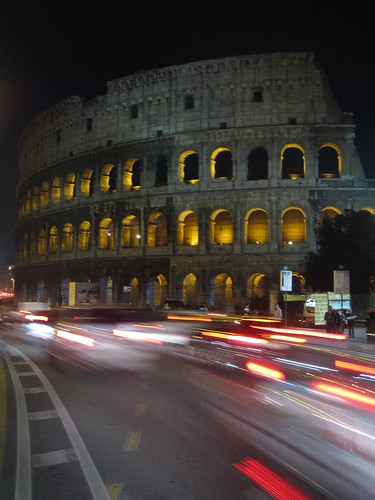 The Colosseum stands today as the most visible link between the great engineering achievements of the Roman Empire and our current understanding of building principles. Somehow, it seems perfectly natural view traffic racing down the Via dei Fori Imperiali right past the ancient edifice. The team of architects, engineers and builders delivered, on their first try, a structure that would set the standard for arena design for 2000 years. To this day, few structures make a stronger statement about the strength of civilization than the Colosseum; Vespasian would have been pleased.
![Reblog this post [with Zemanta]](https://lh3.googleusercontent.com/blogger_img_proxy/AEn0k_srp2aeS70SNtFtmgo8EXRzuAyM5MQOq4iz02sPTX2z4Hk02u0IcqeJXFyu1rKi7nau5EzITOILZArvWRGBM9FCbGZL8TqAyWvpwMkGx9_BZJP1AWbOzFQ_qE7y1HJfcWg-CT7lCX8pf75Nnh_joyjf=s0-d)


![Reblog this post [with Zemanta]](https://lh3.googleusercontent.com/blogger_img_proxy/AEn0k_sF37axNrlhg7_h-xlKo4WwBbnZ5zjdONyCrc5v2jgvrx7RGb2ZQJgSuQpZfJwccInxWJtKS8B61K1xxokbNILD-7QQxHj9-EXdDuYRuLGpyYvXCPeGcpkpqJQE7paB4tjvQSdLYIrZroXLoHKeGp91=s0-d)

![Reblog this post [with Zemanta]](https://lh3.googleusercontent.com/blogger_img_proxy/AEn0k_vcYB8B8lpr-vcTa-5-DB0p7r7sogvg9g6-0QjqdufAodpeCTVX_HRQr7hKHlfS2e3N5gw8DBREShF6infqnoM29BNaKk65YtGlohG7OuZu4fmsKzKuQMhihDKBWKtz36gbP77xBEVuN9Ggps2p_oc=s0-d)
![Reblog this post [with Zemanta]](https://lh3.googleusercontent.com/blogger_img_proxy/AEn0k_sC-qZzBsReo-0w32EfsiABKDgwUKFvERDsT0irDGXu4YAZTEq_FXmM_u-40cXG5_Utt_0kvMrtjcnAWbZKWM5i1T6fr4y3fj6oPGmXJMqZqZ144yu-oYQGvuBjkGiYwU4sUP2Aok_MTr6Jpfi2KL0=s0-d)


