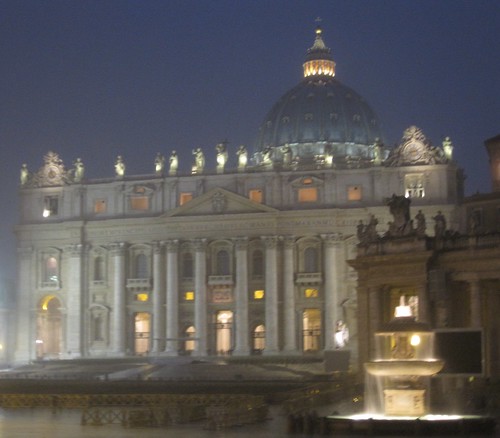
From the top of
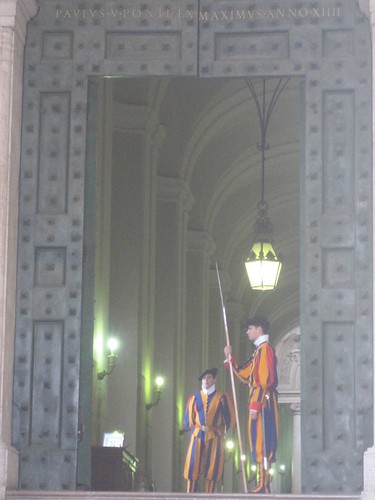
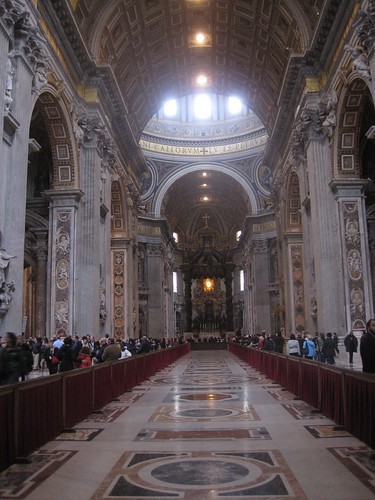
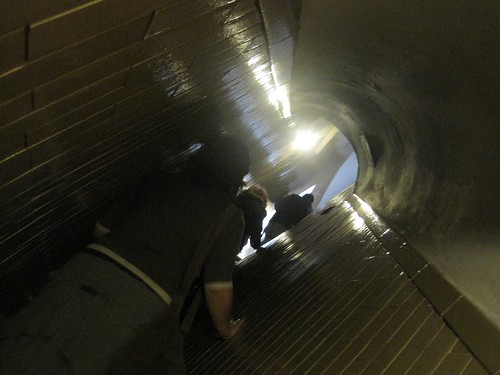
St. Peter’s Basilica I retraced my steps back down the 400-some steps. On the way I stopped at a few of the souvenir stores, still on Vatican premises. Each of the little shops was manned by a small cadre of nuns. While each store sold pretty much the same collection of charms and crosses, the nuns were very strict about paying at the correct cash register. I assumed that they each represented different charities or orders, given turns to man the shops. I purchased a few pendants and an small plastic bottle to bring some holy water back for my grandmother.
Immediately upon crossing the street outside the Vatican, I realized that I could have purchased the very same trinkets for about half the price. Well, at least I could package my gifts in authentic Vatican paper sacks.
By the time I glanced through a few more stores, I was starving, but again caught in a touristy part of town. I did not want to pay 10 Euros for a sandwich again. Then, as I passed by one alley, I noticed dozens of students sitting on the stoop of a pizza joint. It seemed like the place to be. I found out why upon entering - pizza by the pound (actually per 100 grams). They had all your typical options: ham, onion, mushroom, and a few others. However, the pepperoni isn’t quite what we imagine in the US. I left with a full plate for a reasonable price.

With a full stomach, I felt ready to tackle the Vatican museum and
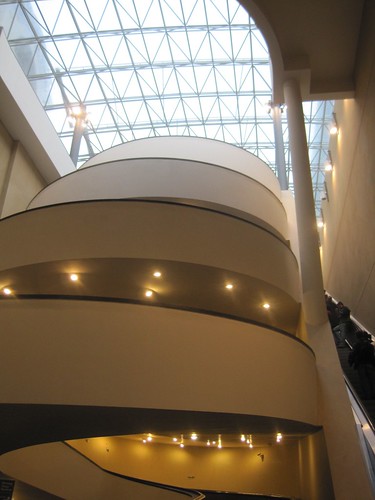
Sistine Chapel. The entrance was around the back side of the small walled city-state. A new ticketing center had been carved out inside the medieval walls. It extended upward, via a creative spiral ramp to a light-filled glass atrium. From there, visitors were directed along various paths through the historic papal residence. I opted to skip the Egyptian and Mesopotamian collection and focus on the works of the masters.

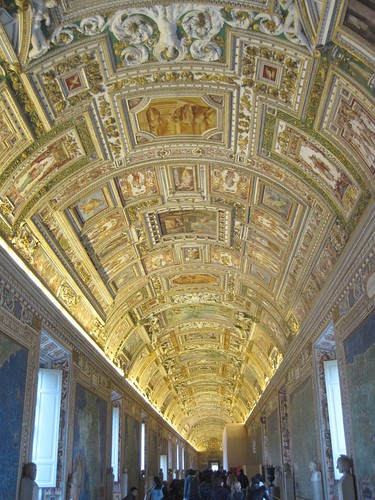
Before arriving at Michelangelo’s definitive works, guests are treated to numerous exhibitions of priceless artifacts. However, I was most impressed with the décor of the palace itself. Much of the current museum was actually the private residence and administrative halls of the Papal court. The opulently decorated rooms reminded me of several other royal palaces that I’ve seen in my travels, most notably the
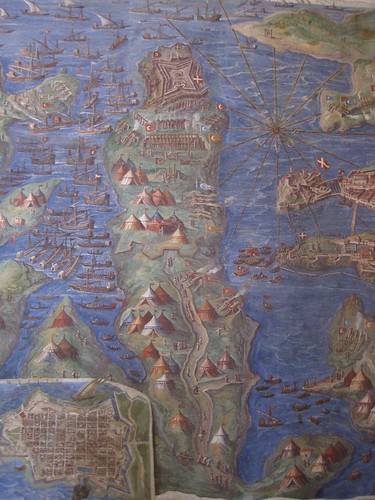
Louvre. My favorite was the map room. In this long hall, the
Pope had commissioned murals depicting all the lands under the watchful eye of the Holy See. Some paintings even depicted naval battles. I was even able to find one map of the region where we lived in France. Unfortunately, Chusclan was not indicated by name, but Avignon and Pont-St-Esprit were noted.

Continuing on, the museum briefly opened up into an atrium containing several classical sculptures and the busts of
Roman Emperors. In a museum collection, this would seem completely appropriate, but one wonders why such respectively pagan and secular images would be housed within one of the most holy sanctuaries of the
Christian church. As I admired some of the sculptures, I overheard a tour guide relating these pieces to the images in Michelangelo’s characters in the
Final Judgment scene. Apparently, he caused quite a stir by depicting some of the holy figures with facial structures identical to those pagan works on display in the palace grounds. Of course, Michelangelo argued that such expressions represented the highest form of artistic expression produced by man. Who were the cardinals to argue with the vision of the great classical masters?
From room to room, signs indicating the direction to the Sistine Chapel teased me forward. Since no maps of the museum were provided, I could only continue onward, taking my medicine on art history. Clearly the curators had an agenda in ushering the visitors through such a progression in styles. The final step in the journey, brought visitors to the Papal suites decorated by Raphael. Belonging to the generation immediately senior to Michelangelo, Raphael and his contemporaries paved the way for Michelangelo’s final leap forward in realistic representation and artistic interpretation. I actually preferred many of Raphael’s paintings because of their colorful vibrance and the way he captured the moment of action in his scenes. Often times the characters in the paintings are caught in between steps as their robes flow around their bodies. It’s easy to appreciate these works for their artistic qualities.


I then descended a
flight of stairs and continued down a non-descript narrow hallway. A simple plaque was all that identified the most famous chapel in the world. Stepping through the threshold near the front of the church, I almost collided with several tourists wandering about looking straight up at the ceiling. It took a moment for me to get my bearings within the empty space; I was hardly impressed until I too looked up. There were all the famous scenes of the bible most famously portrayed by Michelangelo. I had not realized, however, that the entire ceiling was covered in patchwork of murals. The frescoes continued half way down the side walls as well, and behind the alter, Michelangelo’s Final Judgement covered the entire wall.
It was a visual overload. The chapel was not the cohesive work of beauty that I had expected. Instead, it appeared more like an obsessive attempt to represent every significant event from holy tradition in one small chapel. Some individual works, like the depiction of God granting life to Adam by touch, was an impressive singular work. But I was otherwise too overloaded to leave with much of an appreciation for the work. Before leaving the museum for good, I returned to the chapel and spent a good ten minutes sitting and reflecting on all the images.

Photos of the chapel are forbidden. That doesn’t really stop anyone. Several guards walk around the room all day just yelling at people not to take photos. Seems like a lot of hassle and disappointment for visitors just because a few dummies can’t figure out how to turn the flash off on their camera - the extreme light of some flashbulbs are known to damage sensitive paintings. I discretely snapped a few photos with my camera at chest level. They turned out pretty well.
After years of restoration work, the chapel now looks almost as good as it ever has. Centuries worth of soot were washed from the frescoes, revealing much more vibrant colors that art history scholars expected. These efforts also revealed more information about the modifications made to the paintings in renaissance times - most notably censoring the nude depictions. Shortly after Michelangelo completed his masterpiece, a new prudish Pope unapologetically went about destroying countless works of art so he wouldn’t have to look at the penises - a real
conservative Christian hero.
I ended up spending the entire afternoon in the Vatican Museum. My journey in art history spanned from 3000 B.C. to present day. The
Renaissance works are the most famous, but I also learned a lot about other styles. One of my favorite sections dealt with early Christian art, circa 100 A.D. These early Christians adopted a lot of customs from other ancient cultures, but added a whole new vocabulary of imagery, especially shepherds and fishermen. At the 5 hour mark, however, I couldn’t stuff anything else into my mind.



![Reblog this post [with Zemanta]](https://lh3.googleusercontent.com/blogger_img_proxy/AEn0k_sAgTJJKl6rs_iUttWCoYQ9avNODfWNh5EtA3Qkpj_I45SBsfvhrM_59eb3hSSH2YAqkWL5V_eOMT_ND1M4Kz-I6TgioE1JWNk1p7URJEATrGUibpnV7T-mst99R4KQtZe9A2F9lSqGNWPTsOlJBM7c=s0-d)

![Reblog this post [with Zemanta]](https://lh3.googleusercontent.com/blogger_img_proxy/AEn0k_ujjZ-C1Q62jZb7w0nF5kiiBIbBuXMcidZ9v4pwasGxcpsEbHAMiF8WGWfFUbe7KMDmlAI5yEdI5yl7ScuVuw0SOWFyQgZZa6xeuVq9pyIfVTLGI8bQibFDw6pwUjy0FUtiYm452HSCoHhsc5KE4xE=s0-d)


