Showing posts with label Rome. Show all posts

Tuesday, December 15, 2009

St. Peter's Basilica

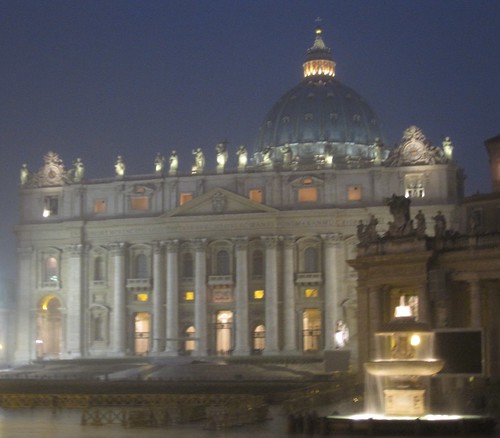
I intended to devote day 2 to the Vatican. Despite being the smallest independent country in the World, you could spend days exploring the monuments and museums housed within the walls. My plan seemed to suit the questionable weather outside. Intending to stay dry, I took the #64 bus from Termini to stop just off of Via della Concilliaziono, the main road leading into St. Peter’s Square.

The weather managed to keep most other visitors at bay. When I arrived at the famous colonnade just beyond Piazza Pio XII, there were few tourists in site. I spent some time wandering around the elaborate circular plaza. Some temporary barricades obstructed the view of the central obelisk, but it was an otherwise perfect time to experience the space.
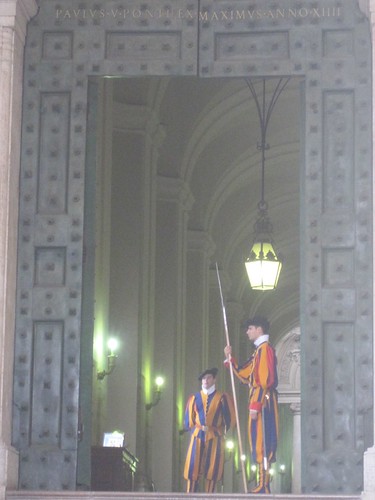
Continuing through the metal detectors, I proceeded in the direction of St. Peter’s Basilica. On the way, I also caught a glimpse of the traditionally attired Swiss Guard devoted to protection of the Pope. They don’t appear to have much to do with the daily tourists though. I was surprised to see that most of the security detail seemed to have city of Rome allegiance. It certainly did not feel like crossing an international border.

I followed the trickle of tourists on toward St. Peter’s Basilica. Surprisingly, we entered right through the front doors. Looking back on the square from the stoop is quite the site. I tried to imagine it packed with people on Easter Sunday or before announcing a new Pope. But the sight of the grand space outside the church could not prepare me for the vast interior.

On the way into the church, visitors first pass through an opulently decorated atrium. Many tourists were snapping photos of the gilded doors. Upon passing through those doors, I was immediately struck by the massive size of the nave. The path to the altar seemed to stretch a mile detailed in intricately patterned marble. Massive columns rose like redwoods to support the high vaulted ceiling. I had been in plenty of cathedrals in my time in Europe, but none could prepare me for the size and spectacle of St. Peter’s Basilica.
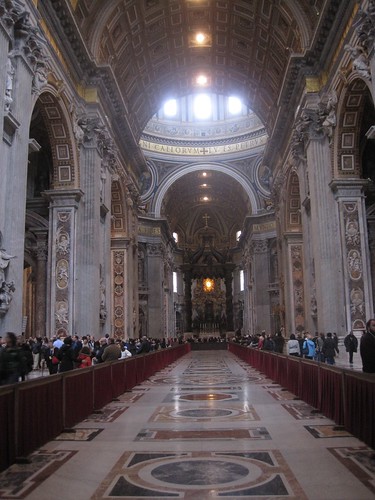
The central path through the church was almost too much to take in. I ducked into one of the side aisles where I could appreciate the numerous works of invaluable art. On this day, I decided not to pay for any of the guided tours, preferring just to experience the art for it’s intrinsic and holy value. As series of chapels lined the sides of the nave until opening up at the great transept that forms the traditional cross in the floor plan.
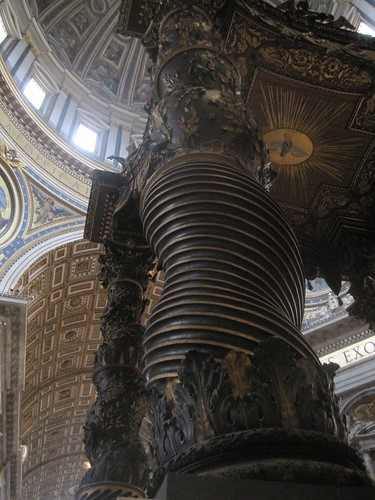
In the center of the transept, the most prominent location within any church, stood a massive stone baldachin. Made of cast bronze, the canopy looked like nothing I’ve seen before in any church. Spiraling columns reach upward to support a sculpted platform protected by four angels at the platform. Later, I learned that this monument was one of the early works commissioned to the famous Roman sculptor, Bernini. According to church tradition, the tomb of St. Peter, the first Pope, rests directly below the baldachin. A staircase leads down to small door decorated with the image of the saint, beyond which lies the crypt.

The structure above is even more impressive. Rising almost 450 ft. (to the top of the cross), the dome of St. Peter’s is the tallest of its kinds. It took almost 150 years of design conception to finally arrive at the structure that completes the space today. Michelangelo and other highly regarded architects of the day, contributed plans for completing the dome inspired by the Pantheon and the dome of Florence’s medieval cathedral. The final result did not match the breadth of either of those domes, but contributed mightily to the vastness of the space below.
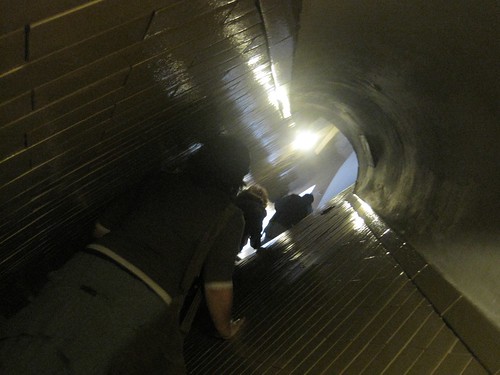
I paid the extra 5 euro fee to walk up the 400 or so steps to the exterior viewing platform. For an additional two euro you can take an elevator up for the first 200 steps. Continuing on from there, you walk between the two shells of the dome. As I continued up surrounded by other tourists, passing the occasional person overcome by claustrophobia, I imagined that this might be what purgatory feels like - spiraling upward forever. At times I was able to glimpse uncovered sections of the dome, that might give some indication of the construction. Unfortunately, neither during my visit nor since have I been able to find a comprehensive description of the structure of the dome.

IMG_4680.JPG

You need not understand the behavior of the dome to appreciate it’s incredible size. And the amazing view from the top speaks for itself. Even despite the overcast sky and gusting winds, I was in awe of the panorama before me. It was fun to pick out the major attractions of the city from this high perch. I also felt like the whole of the Vatican was literally a stone’s throw away. From this vantage, I briefly reminisced my journey to date and considered what was next. Would anything compare with the sight I had already seen?

View more of my Vatican photos on Flickr.
Reblog this post [with Zemanta]

Sunday, December 13, 2009

City at Night

This post again recounts part of Day 1 of my Rome trip. The city is enthralling like that. There are so many sites to see; you feel compelled to continue on and on. Already, this day had included an early morning flight, checking into a hostel, exploring the ancient ruins of the Forum and Palatine Hill, visiting the Colosseum, and experiencing the Pantheon. Still, there was time to see a few more attractions. As the sun set, the lights of the town began to glow, and an entirely different city was waiting to be explored.

From the Pantheon, I followed a young family to the nearby Piazza Navona. Attempting to keep the children’s attention after what I assumed to be an equally exhausting day, the father informed that they used to race cars here around the fountains. On this night, I couldn’t have imagined an auto race. A Christmas market was being held in the Piazza. Dozens of Christmas trinket stands and candy vendors were organized in neat rows in the oval shaped plaza. While adults shopped for wooden manger figurines, teens loitered around the fountains wondering what might come next in their night.

After making the rounds myself, I struck out in a new direction, this time hoping to find a good place for dinner. My feet were sore and my stomach was rumbling, but it still seemed like a fine night for a walk. My southbound path next took me to the Campo de Fiori. In this city of plazas (at least 21 warrant their own page on wikipedia), they all start to run together. At this location, I only remember that the retail stores along the narrow path leading to the square remained open at least to 8 pm.

Continuing on, I passed a street car station just in time to hop on and save my feet a few more blocks of walking. My final destination of the night was St. Maria in Trastevere. The church is known to have beautiful mosaics inside, but I wouldn’t know. I was on the hunt for a reasonable place to sit and eat, and I was told that this neighborhood, south of the Tiber, was the best in town. There were too many choices. Of course, I wanted Italian, but how do you rate one pasta menu over another.

I decided to avoid the restaurant advertising that they stood opposed to “war and tourist menus.“ I didn’t know what that meant, but I didn’t exactly sound inviting to an obviously American traveler. Eventually I settled on a small pub packed with patrons waiting to watch the Real Madrid take on the defending Champions League winners, FC Barcelona. The establishment even boasted free wifi. I was able to send emails to a few friends while watching the game, enjoying the cannelloni and drinking some Italian brew. The food and the atmosphere was exactly what I was looking for that evening. With each scoring chance, it was plain that the patrons were pretty evenly split between support for each team. Even if the final score was only 1-0, I had a great time and was suitably rejuvenated to make the trip back to the hostel. It was a perfect ending to a magical day in Rome.

Reblog this post [with Zemanta]

Friday, December 4, 2009

Palatine Hill

About an hour and a half into my first tour, the long day was starting to catch up to me. However, off to the south, an intricate series of man-made terraces needed inspection. These brick archways formed extended the slope of the ancient Palatine Hill. The earliest archeological remnants of Roman civilization were found here. It’s also the mythical setting for the stories of Romulus and Remus, founding brothers of Rome. In later times, still ancient history to us, the wealthiest senators, Cesars and royalty made their homes in this prominent location.

Palatine Hille

The way up from the Forum takes visitors through the renaissance gardens of the Farnese family. Historians argue whether their landscaping adequately pays tribute to the early history of the Roman hillside or disrespects the later work of the Empire. Such real estate saw many redevelopments as the property changed hands. In my opinion, the gardens and villas pay adequate homage to the spirit of the much admired address.

The top of the hill provides the best views down to the Forum. From here you cans see all three victory arches and even as far as the Colosseum. From this perspective, you can imagine what the site would have looked like in antiquity. With the building plans laid out below, it takes just a little imagination to project the lives of the senators, priests and priestesses working to keep the public institutions of the Empire in motion.

IMG_4505.JPG

Further on, past the gardens and to the opposite slope, visitors encounter the remains of the oldest and most sacred sites on the hill. Here researchers have uncovered Romulean Huts from the very beginnings of recorded history. Digesting all of the information and keeping all the sites in chronologic order becomes too much in one afternoon, however. At this point, I began selectively jumping to only the most visually interesting audio points.

Without doubt, the most impressive and important structure on the hill belonged to the Cesar. Although Augustus constructed a modest residence on the hill (using his own money no less), the Domus Flavia palace was the real trend setter. This sprawling mega-plex included beautiful baths, numerous residential suites, executive offices, a Nymphaeum (you wouldn’t want your playful virgin demi-goddesses to go homeless) and a private hippodrome. An ego driven construction to be sure, it was also necessary as full control of the State was placed under executive control. The major mechanisms of government would now be fulfilled on the Palatine Hill.

Four hours and a couple thousand years of history and still I had not seen the ultimate symbol of Roman power. The Colosseum was up next.
Reblog this post [with Zemanta]

The Forum

From the main boulevard that leads to the Colosseum, an inconspicuous gate leads into the site of the ruined Roman Forum and Palatine Hill. It’s very easy to miss because your view is instinctively drawn to the spectacular ruins just beyond. The Colosseum beckons from the end of the the Vie dei Fori Imperiali and the forest of free standing columns calls to the right. I used my pre-purchased Roma Pass, which covers admission to two museums and unlimited public transport, to skip to the front of the entrance line. Beyond that I was drawn down the Sacred Way like a fly seeking the light.

Roman Forum Sepia

Regaining my senses after the initial wave of architectural euphoria, I returned to the entrance to purchase the personal audio guide. It’s also possible to join a live tour, but I wanted to explore on my own for a bit. Over 40 different locations are discussed in detail on the audio guide. I dutifully returned to station number one and began the history lesson.

After the general layout of the site was described, I immediately saw the similarity to the Mall in Washington D.C. The placement of the Presidential memorials, Smithsonian Institutes and war memorials around a central public space is highly reminiscent of the Roman Forum, just to a super-sized American scale. The parts of the Roman Forum that are remain uncovered today relate closely to the functions of the representative State government and religious worship.

One of the oldest colonnades belongs to the ruined Temple of Jupiter, king of the Roman gods. The large plain Ionic columns stand despite the torments of time. In fact, this temple and many others of the Forum were destroyed numerous times in antiquity. The elements that survived were highly regarded by many ancient cultures or re-purposed. Archeologists also note that the current excavated level of the Sacred Way is several feet below its constructed level in Christian Rome. For that reason, the entrance to some remaining monuments seems strangely elevated above the modern path.

Temple of Jupiter

The Curia, or Roman Senate, has survived because it was converted into a chapel by the church. The preserved mosaic marble floor is one of the most impressive aspects of the ancient building. Compared the Cesar’s palaces and public works, the building fairly modest. Could that unusual display of modesty by the Roman leaders have been in light of cost conscientious public? Like the US House of Representatives, it’s difficult to imagine the 100+ senators congregating in the under-sized space.

All other monuments seem to be outrageous in scale. Of these, the Basillica of Maxentius is the most impressive. Three huge arched ceilings survive. As massive as the structure still appears today, we can only view a third of the space. It was so large that records show that multiple functions were often held concurrently, separated by large curtains that hung from ceiling. Despite the name, this structure was not originally used for religious ceremony. Several other temples on the site served the functions of god worship - including the posthumous establishment of cults to a former Cesar.

Basilica of Maxentius

The most interesting stories are associated with the temple of Vesta. This goddess was particularly important, because the preservation of her eternal flame, allegedly spirited away from Troy when it was sacked, guaranteed protection to city of Rome. A cult of priestesses, known as the Vestal Virgins, maintained the flame and, in return, were granted unprecedented privileges. They attended social events as special guests, travel by carriage around the city and could commute the sentences of death row inmates. After 30 years of service, the women chosen for their unparalleled beauty were finally able to marry. If on the other hand, they were found to have violated the terms of their pure existence, they were immediately put to death.

Finally, the war memorials are among the best preserved monuments on the site. These Arches of Triumph commemorate several decisive victories in the history of the Empire. The arches of Septimus Severus, Titus and Constantine form the axis of the Sacred Way. Titus’ arch depicts the victory of Rome in Jerusalem and the return of the Holy Land to the Empire. Constantine’s arch shows his victory over a rival and the adoption of Christianity as the state religion. He shrewdly uses popular symbolism to credit his supporters and speak to the people of Rome.

In these ruins, the history of Rome is well recorded. For better or worse our impressions of the Roman people and their empire are largely drawn from the remains of monolithic places such as these. It makes one wonder, how will future societies judge America based on war monuments and memorials featured in our nation’s mall?

Reblog this post [with Zemanta]

Funny Palace (of Rome)

As much as we complain about modern travel, it really is something amazing to travel by highway, high-speed train and airplane. A trip to Rome from France was at one time the culmination of a life’s effort to raise the funds and a long and dangerous journey over land and sea. For all but the fantastically wealthy, this pilgrimage was fantastically difficult. I was mildly inconvenienced by having to travel to Lyon the night before in order to make the 4:45 am bus to the airport for my 7:00 am flight.

Roma Termini

Another bus ride from Ciampino airport was required before I could definitively say that I had arrived in Rome. The bus dropped me off at Roma Termini, the central train station and starting & ending point of all adventures in Rome. My hostel was conveniently located only a few blocks from Termini. Despite being quite groggy from my early morning travels, I easily followed the directions provided by hostelworld.com to Funny Palace Hostel. I hoped that the funny name was just the result of an unfortunate translation.

Despite the odd sounding name, reviewers had highly rated the hostel. They warned, however, that the check-in seemed a little sketchy. The owners of the hostel rooms also ran an internet and laundry service. Entering through the front door, I was ushered to a simple table nestled between computer stations and washing machines. Immediately, Mabri, my host, began planning my stay in Rome. Though it was 10am, he also offered a bottle of wine.

Mabri suggested that I see the Colosseum and nearby Roman ruins to start my day. He had tricks for avoiding the long lines. Like: buy your ticket at the entrance to the Forum, because it’s also good for the Colosseum but isn’t as busy in the morning. Also, go up Via dogi Annibaldi for the best view of the Colosseum (note that you cannot access the entrance from that street). On day two, I would visit the Vatican. Remember, Mabri urged, to look for the #40 and #64 busses from Termini. If I was up for a long walk, he suggested a half dozen sites of interest between the hostel and St. Peter’s. Finally, I left with coupons for free breakfast and some discount cards for local restaurants.

Map of Rome

The room was quaint and the bed was comfortable - not that I would have much difficulty sleeping after all the walking. I shared a room with three other travelers. They were all nice, and I even shared dinner later with a couple of Aussi’s. This was their first time to Europe. For once, I felt like the seasoned traveler. I figured that would prepare me well for my whirlwind tour of Rome.
Reblog this post [with Zemanta]
 
Creative Commons License
This work by Ken Maschke is licensed under a Creative Commons Attribution-Share Alike 3.0 United States License.