
Another bus ride from Ciampino airport was required before I could definitively say that I had arrived in Rome. The bus dropped me off at Roma Termini, the central train station and starting & ending point of all adventures in Rome. My hostel was conveniently located only a few blocks from Termini. Despite being quite groggy from my early morning travels, I easily followed the directions provided by hostelworld.com to Funny Palace Hostel. I hoped that the funny name was just the result of an unfortunate translation.
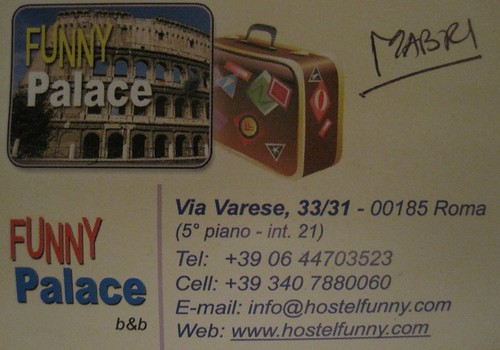 Despite the odd sounding name, reviewers had highly rated the hostel. They warned, however, that the check-in seemed a little sketchy. The owners of the hostel rooms also ran an internet and laundry service. Entering through the front door, I was ushered to a simple table nestled between computer stations and washing machines. Immediately, Mabri, my host, began planning my stay in Rome. Though it was 10am, he also offered a bottle of wine.
Mabri suggested that I see the Colosseum and nearby Roman ruins to start my day. He had tricks for avoiding the long lines. Like: buy your ticket at the entrance to the Forum, because it’s also good for the Colosseum but isn’t as busy in the morning. Also, go up Via dogi Annibaldi for the best view of the Colosseum (note that you cannot access the entrance from that street). On day two, I would visit the Vatican. Remember, Mabri urged, to look for the #40 and #64 busses from Termini. If I was up for a long walk, he suggested a half dozen sites of interest between the hostel and St. Peter’s. Finally, I left with coupons for free breakfast and some discount cards for local restaurants.

The room was quaint and the bed was comfortable - not that I would have much difficulty sleeping after all the walking. I shared a room with three other travelers. They were all nice, and I even shared dinner later with a couple of Aussi’s. This was their first time to Europe. For once, I felt like the seasoned traveler. I figured that would prepare me well for my whirlwind tour of Rome.
![Reblog this post [with Zemanta]](https://lh3.googleusercontent.com/blogger_img_proxy/AEn0k_u8rbw1oKr-Z3dp_sSeIanTX4WPIlwuQaM6KUxVRFZR328Xr29FM6g5qckcBXxr3JNYECgfBM2FTxCrvw5KPPBa0kbugZa8pOD47gb3u7YCz069TA5Z30JtyUe3KTv5XhzrY_QVEUwbfC484hglaW4u=s0-d)


![Reblog this post [with Zemanta]](https://lh3.googleusercontent.com/blogger_img_proxy/AEn0k_sBjpuqywtfVbWzppk4_pykeLBamXW27xa7pcIHbVyDEqKI7QH1BwiBITiah9E7T2oAMgLbKmV2fZsW6FPO6OaG61q-ycP-sEpPEaSltauEJeYwJ71YZqnyYzlt0tLU1jhCHFdwGTdvc86tf6UX9uwx=s0-d)


