Showing posts with label Wine. Show all posts

Monday, October 12, 2009

Rosés are only slightly red

The festival in Chusclan draws wine devotees from around France. Châteauneuf du Pape exports one of the most famous labels of red wine. But for a truly unique local wine, you must visit the sister cities of Lirac and Tavel, home of rosé wine preferred by kings.

picture0005 picture0004

Both villages have their own unique Appellation d'Origine Controlée. However, Tavel only produces rosé wines. It's said that Louis XIV and Philip IV traveled through the region and enjoyed the wine. According to legend, the latter declared Tavel's brand of rosé the only good wine in the world.

Like most Côtes du Rhône wines, grenache, syrah and mourvedre grapes are predominately used. But whereas many rosés are simply made by blending red and white wines, that process is strictly forbidden by French A.O.Cs. Instead, the grape skins are allowed to ferment with the wine for a short period of time. In Tavel, an extra step is added to the process allowing for a more powerful flavor from the wine.

The best thing about this local variety of Rosé: you don't need to wait for a long fermentation period in the cellar.
Reblog this post [with Zemanta]

Chateauneuf du Pape

Though Chusclan might have a local reputation for producing quality Côte du Rhône A.O.C. wines, it is by no means as internationally renown as Châteauneuf du Pape. This small wine-obsessed village is located just a few miles outside of Avignon, home to the Popes through much of the 13th century. During their reign, wine production benefited from their Papal influence. The latest techniques were applied and the vine stock greatly improved. The modern success of Châteauneuf de Pape is still linked to Avignon and the reputation that is spread by the numerous international visitors that visit the famous walled city.


Our trip to Châteauneuf du Pape was less based on touristic interests than our own appetite for good wine. We had asked some friends to check out our local wine super-store in Chicago to see if any of the local cooperatives were represented. Only one variety was widely available: the rouge of Châteauneuf du Pape. Though white and rosé wines are also produced, the region northeast of Avignon is most well-known for its deeply colored red wine.

Upon arriving in the small village, we proceeded to the office of tourism for some help in finding wine tasting venues. A light-up board provided our answer: go in any direction. The city is littered with mini-caves (pronounced in a Mayor Quimby way, as in cod) for tastings. We set a rule to avoid those with neon signs and flashing lights.

Our first stop was already being patronized by two east-coast Americans. They intimated that their wine selection was worth the hype. We tried a few rouge samples and settled on an aged bottle that agreed with our palate. The price was 27€, previously unheard-of in our wine tasting adventures. The best quality wine in Chusclan is less than half the price. Nevertheless, we were committed.

We continued up in the direction of the castle ruins at the top of the hill. On the way, we passed an unassuming cave in a cave-like cellar: Cave due Veger. Walking through the dimly lit passages, we encountered a large group of North Americans, well into a multi-flight tasting. We were encouraged to join in. The French wine-master began a quick recap of the tasting, beginning with some light white wines. He implored us to use our imaginations to pick out the various scents and flavors in the selections. In one case, he told the story of a child describing the smell of one wine as honey-nut Cheerios. The kid was exactly right.

We were scolded repeatedly for taking wimpy whiffs and holding the glass improperly. Never touch the bulb, it warms the wine and leaves ugly smudges during a meal.

To approximate the aged taste of the wine, he explained how to slurp the wine - like whistling backwards. Be careful, though, too much gusto and you'll look decidedly uncool coughing up your sample. Done right, we learned to feel the taste from the front of our mouth to the back of our jaw. Fruits up front, tobacco-like sensations in the back. A good classic French wine, we were told, should taste like the leather from an old set of worn farm boots deep in your palate. Fruity wines are for women.

All the while, the others in our tasting company peppered our host with food pairing questions. A gentleman from Atlanta wanted to know what would go best with grilled dates wrapped in goat cheese. Not to be outdone, the women from Ontario suggested some traditional Canadian fare. As casual observers this played out hilariously as we could read the wine experts impatience with such neophytes. Suspecting that the group on a privately run excursion would pay handsomely for his wares, he played along.

The final test came when we were presented with a fruity desert wine - like an ice wine, but not produced according to those rules. We were challenged to come up with six different fruits and and one flower. Mary Ann and I successfully guessed none of them, though our generic guess of citrus did in fact describe the most prominent taste of a ruby-red grapefruit. Who cares what was in the wine, it tasted good. We left with another $30 bottle of wine from Châteauneuf du Papes.
Reblog this post [with Zemanta]

Celebrating Wine (day 2)

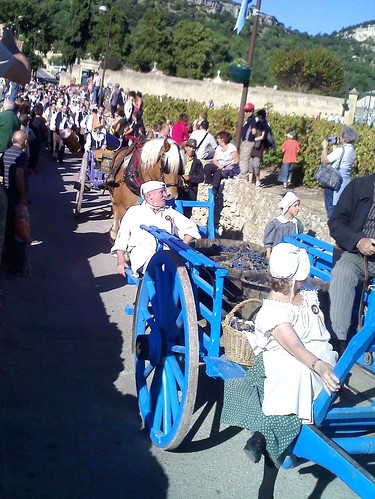
Our antique car disaster was not enough to keep us from day two of the biggest party of the year - in Chusclan. Again, our landlords insisted that we arrive in town early to see all the dancing and singing and Provencal merry-making. To our surprise, Chusclan was even busier than the day before. And even more people were wearing their old-time costumes. We had elected to go as typical tourists... in case we were stranded somewhere again.

Our first stop was at the accueil (welcome) table to buy our wine tasting glasses. For just 3.50€ we could enjoy unlimited degustation (tasting). The best, and classiest, part of the tradition is that the glasses are mounted on strings so you can wear it around your neck all day. That way you never lose any time between rounds searching for your glass.

Madame Bérard again showed us around town, making a point of directing us to the very best wine tasting stands. I think we visited the Champaign stand three times. In all there were about a half dozen different wine cooperatives represented around town. Of course we had to try them all. Now with three months of wine tasting experience, we really felt like pros swirling, slurping and making funny faces. As expected, the local wine was the best - I mean, why would you invite someone with better goods to your wine party?

All day, local residents played the part of peasants from the 1800s. I was most impressed by the guys shoeing the horses. I was a little surprised that the horses were so accommodating, allowing the smith to manhandle is massive hooves. Nearby, a faux-nun pretended to scold school children, women washed the same white linens for hours and an accordion player flipped through this collection of classic tunes.

Meanwhile a drum and whistle band was supplying the music for a troupe of dancers. Professional might have been too strong a word to describe both groups, but they certainly held the tourists' attention. The most impressive dance was performed around a pole with colored streamers flowing from the top. Each dancer grabbed a streamer and followed joined in dancing around the pole. The choreographed movements resulted in a colorful braiding - pole dancing a la 1830.

Braiding Pole Dancers

Around 3:00 the mayor announced the grape harvest. The costumed residents look their places in a parade of donkeys and dancers and processed out of town and to the nearest vineyard. The mob of tourists followed. Reaching the end of the field, the mob disbursed among the vines and began collecting grapes. Large wooden barrels were filled and mounted on the mules. The procession then returned to town to celebrate the pressing of the grapes.

Unfortunately, this local celebration did not include an grape stomping. However, the freshly squeezed grape juice was collected in a large cask and served to the brave. It actually tasted pretty good - very sweet, not much different than your highly processed supermarket variety.

See more photos of the Chusclan Vendanges de L'Histoire on my Flickr page.

Reblog this post [with Zemanta]

Friday, September 25, 2009

Harvest Time

The grape harvest started a few weeks ago. It was earlier than normal this year due to the odd weather conditions. We learned that spring was quite wet, but the summer months were dryer than normal. I assume that this is going to lower the yield on this years' crop. Expect your 2009 vintage Côte du Rhône wines to be more expensive, due to scarcity.

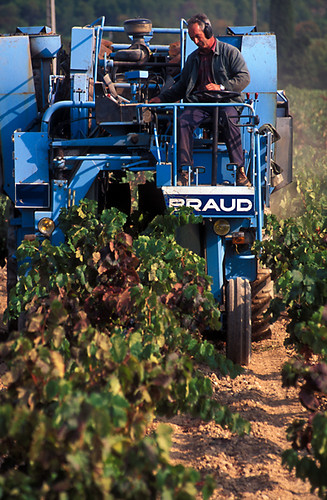
Nevertheless, the harvest continues. It doesn't just happen over a long weekend. Despite the introduction of mechanized harvesting machines, it takes time to pick all of the fields. Apparently, the new equipment is only a few decades old and just recently perfected. I cannot fathom how long it must have taken to harvest the grapes by hand. They must have needed thousands of laborers. Seems a little anti-socialist to remove so many jobs, doesn't it (see, the French are just like the Americans. No one wants to do the dirty work, and they don't like their immigrant workers either :(

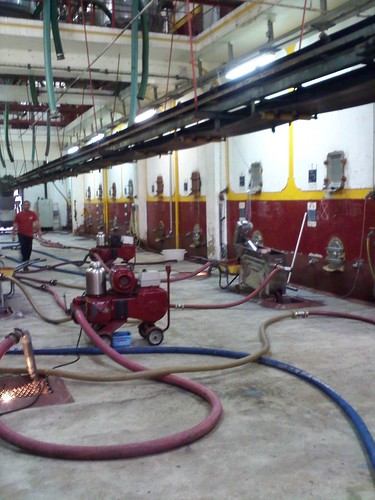
The grape picking machines can hold about two tons before having to unload. The wagons are then pulled by tractor to the local cave-cooperative. At the cave, the grape varieties are stored in separate bins and then processed automatically. No grape stomping here either. Wine production is big business, and the technology applied is equivalent to the factory farms back home.

When you visit a local cave for a wine-tasting, you might have the opportunity to peek back into the work room. Don't expect to see the mashers sitting on the floor though. Much of the process actually takes place in the basement, allowing for easier delivery from the grape haulers.

The Appellation Contrôlée claims to monitor the growing and processing of the grapes for strict adherence to the tradition of making wine in the region. I wonder how seriously that can be taken given the noticeable recent advances in technology. In any case, the taste of the wine is not diminished by the robotic touch. The popularity of wine is as high as ever.
Reblog this post [with Zemanta]

Tuesday, August 4, 2009

Apéro

Dinner time in France is typically well after 7:00. Lunch is still taken around noon. How do they make it that long? Although snacking is generally discouraged, having an apértif with some small dishes is ingrained in the culture.

French pastisImage via Wikipedia

Apértif drinks are listed separately on the menu, so you don't make the mistake of ordering a digestif (after dinner drink). Mary Ann prefers a kir made with white wine and crème de cassis. Pastis, an anis flavored drink served with equal part water, is really growing on me. You should have your apértif with sliced baguette topped with tapenade (olive paste, yuck), paté (the best use I've seen for liver) or cured sausage (just beware of the organic farmers and their real intestine casing).

Apéro with the Bérards usually turns into a two hour event. Madame periodically retreats into the house to produce another extravagant dish or homemade liqoure. By the time we've finished the Apéro, we're stuffed with food and stumbling to the apartment. The ritual is quintessentially French and one that we've begun to adopt into our daily routine (sans the drunken stupor... usually).
Reblog this post [with Zemanta]

Thursday, July 30, 2009

Dégustation

Is there an art to wine tasting? The French seem to think so. Being able to pick the right wine for the occasion is a matter of pride. Local wines, however, always seem to have the leg up on the competition.

Chusclan is home to many award-winning vintages. Most of the villages in our region belong to the Côte du Rhone AOC (Appellation d'Origine Contrôlée). This means that the types of grapes used, the aging process and even the way the grapes are grown are all closely monitored by an independent organization. In theory, this promotes consistent quality and adherence to the traditional customs of the region. For this reason, you will not find many sweet wines in this area.


Don't worry. The wines are still smooth and fruity. Rosé is a traditional specialty, but we've been very impressed with the Rouge. And that's really saying a lot coming from Mary Ann. Of course, you'll have to find your own favorites.

For that, the local wine cooperative is fully stocked and ready for tastings. The cave is the only retailer in the village that is open seven days a week and maintains consistent hours. And you can usually count on someone being able to speak near-fluent English to help you through the process. On my first visit to the Cave, with my Mother in law, we tasted four rouge and two rosé wines. The final selection in each flight was a clear winner.


We each walked away with two bottles of wine. Why stop there? The price for the quality is super cheap. Our most expensive 2004 vintage rouge titled, "Excellence" was less than 8€. The French sometimes complain about the prices, but they have no concept of what these wines are going for in the States. Then again, when wine is cheaper than water, you'll indulge enough to make up the difference.
Reblog this post [with Zemanta]
 
Creative Commons License
This work by Ken Maschke is licensed under a Creative Commons Attribution-Share Alike 3.0 United States License.