Wednesday, October 7, 2009

Le Grau de Roi

On his way out to sea from Aigues Mortes, Saint Louis would have first had to navigate a narrow inland channel, called a grau. Along the way, his view would probably have been similar to the one that modern visitors enjoy. Riverside reeds provide a habitat for feeding flamingos. Camargue bulls graze on dry plains between the marshes. Farmers store their sea-salt harvest in tall mounds. With the exception of some sprawling harbor communities near the city, local managers have done a good job of preserving the unique natural habitat.

picture0060

Finally the waterway, cuts through le Grau de Roi, so named in honor of Saint Louis’ first passage, and spills into the Mediterranean. Today, the city is a major tourist destination. The canal through town is lined with restaurants, offering the day’s freshest catch. Further inland, the city streets provide a menagerie of traditional tourist trinkets and apparel. The rows of Slushie machines reminded me of Bourbon street.

picture0029

An expansive sandy beach stretches for miles along the coast. However, except for the ocean channels dug to allow the fishing fleet to exit to the sea, the water level is low. At low tide, it’s possible to walk all the way out to the breakwaters, several hundred meters out from the boardwalk. Developers have seized on the opportunity to build along the beach and erected all sorts of odd pyramid and wave-form shaped time-share buildings.

Fortunately, we visited on an off-season weekend. This allowed us to stay in an excellent high-end hotel (3 Logis lamps!). But, most importantly, it meant that the traffic and crowds were manageable. Given the vast numbers of condos, I could not imagine visiting in season.
Reblog this post [with Zemanta]

Tuesday, September 29, 2009

Aigues Mortes

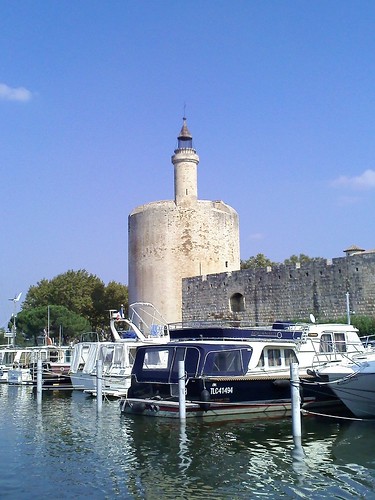
Before embarking on his famous but ultimately futile crusades, Saint Louis (King of France) realized that his nation didn't have a suitable Mediterranean port. The spot he chose for his new naval fortress was located in the salt marshes of the Camargue. This region was largely considered uninhabitable at the time. Cholera and pestilence were spread by mosquitoes bred in the still waters. The locals called it Aigues Mortes, meaning dead water.

picture0044

Unswayed by difficulties in encouraging workers, settlers and soldiers to relocate to the region, he pressed on and re-construction of the town was completed around 1248. The fortress city was expanded by later French Kings.

Only the Constance Tower remains of Louis' original fortifications. Its thick walls are considered impregnable, perfect for a prison. Following revocation of the Treaty of Nantes, which had granted Calvinists some freedoms in Catholic France, Aigues Mortes' walls were used to imprison the protestants. The tower of Constance was duly named after a female inmate who spent 38 years in captivity.

Over time, the shifting alluvial basin of the Rhone rendered the port of Aigues Mortes unnavigable to ocean-going vessels. This, in effect, served to preserve the medieval city. Its now regarded as one of the most complete medieval naval fortresses in Europe. As such, its a huge tourist draw. The crusader armies have been replaced by legions of retirees. Instead of riding horses through the city streets, tourists can board the senior train for a guided tour in five languages.

picture0035

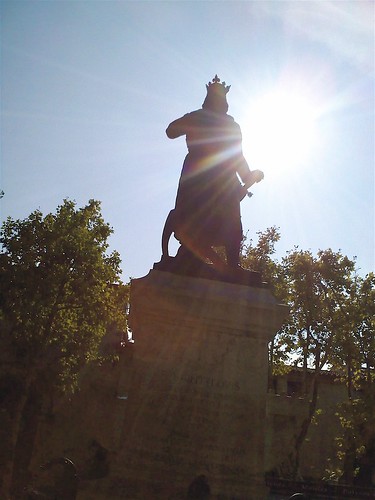
Despite its dangerous past and touristy present, Aigues Mortes is a unique and enjoyable city. After wandering around the ramparts, it's best enjoyed with a crêpe and café in the central square right in front of the statue of Saint Louis.


Reblog this post [with Zemanta]

Friday, September 25, 2009

Harvest Time

The grape harvest started a few weeks ago. It was earlier than normal this year due to the odd weather conditions. We learned that spring was quite wet, but the summer months were dryer than normal. I assume that this is going to lower the yield on this years' crop. Expect your 2009 vintage Côte du Rhône wines to be more expensive, due to scarcity.

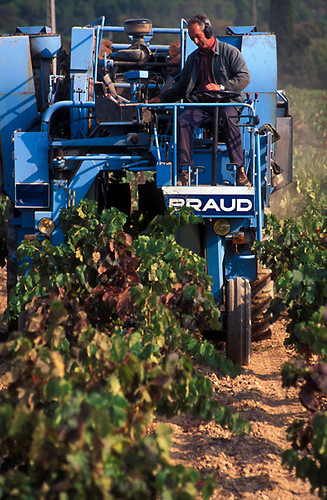
Nevertheless, the harvest continues. It doesn't just happen over a long weekend. Despite the introduction of mechanized harvesting machines, it takes time to pick all of the fields. Apparently, the new equipment is only a few decades old and just recently perfected. I cannot fathom how long it must have taken to harvest the grapes by hand. They must have needed thousands of laborers. Seems a little anti-socialist to remove so many jobs, doesn't it (see, the French are just like the Americans. No one wants to do the dirty work, and they don't like their immigrant workers either :(

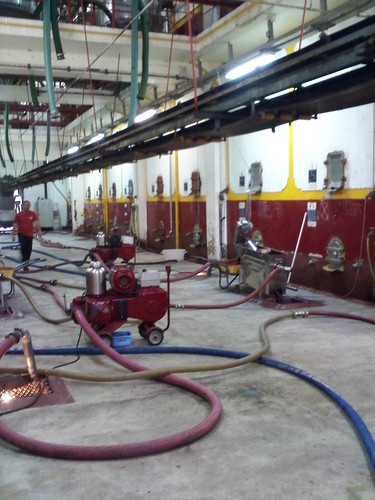
The grape picking machines can hold about two tons before having to unload. The wagons are then pulled by tractor to the local cave-cooperative. At the cave, the grape varieties are stored in separate bins and then processed automatically. No grape stomping here either. Wine production is big business, and the technology applied is equivalent to the factory farms back home.

When you visit a local cave for a wine-tasting, you might have the opportunity to peek back into the work room. Don't expect to see the mashers sitting on the floor though. Much of the process actually takes place in the basement, allowing for easier delivery from the grape haulers.

The Appellation Contrôlée claims to monitor the growing and processing of the grapes for strict adherence to the tradition of making wine in the region. I wonder how seriously that can be taken given the noticeable recent advances in technology. In any case, the taste of the wine is not diminished by the robotic touch. The popularity of wine is as high as ever.
Reblog this post [with Zemanta]

Wednesday, September 23, 2009

Customer Service Complaint #999

Europcar, you're up this time in the never-ending carousel of incompetent customer service providers. I'm willing to overlook the two hour wait for my vehicle in Paris because the busiest airport in the world was only staffed by one lone worker who had to retype every personal data field separately into three computerized forms. I might even let the 30€ diesel fuel vehicle surcharge on gasoline engine pass.

But, do not think for a moment that you are going to sneak by a 600€ up-charge for extending my contract. Why would I ever pay 50% more than the basic online rate for the privilege of driving a Ford Fiesta? The daily rate that I was told at the counter was substantially lower than the rate I was billed over one month later. Oh, yeah; and I will not pay the extra VAT on a contract that clearly stated online that it was included.

You're sneaky SOBs. It's clever how you discretely tossed by original contract when I had the vehicle renewed. It was also clever that you billed two different credit cards. Fortunately, I've got the time and the desire to get my money back!
Reblog this post [with Zemanta]

Country Day

Classic muscle cars, Harleys, chocolate chip cookies, straw hats and line dancing: it's Country day in Chusclan. Although the village is located in rural France, the term country is obviously means a celebration of American country life. I'd say they pretty much nailed the experience too. The only things missing were some confederate flags, a reproduction of the General Lee, and a dozen or so beer-bellied men with coozies.

Muscle Cars

Don't be fooled by France's stubborn insistence that there never were any weapons of mass destruction in Iraq, they admire America culture. I could not image my home town having a France day complete with crêpes, accordion music, and classic Renaults.

Country Days in France

Despite iffy weather, a lot of visitors, including the local French branch of the Hell's Angels, drove into Chusclan. The presence of too many motorcycles so disturbed the planning committee, that they had signs directing where to park every dozen yards. Rules breakers to the end, only a handful of motos were actually parked in the proper location.

We didn't stick around for many of the festivities. An authentic chocolate brownie more than met our appetite for American nostalgi.
Reblog this post [with Zemanta]

Tuesday, September 22, 2009

Health Care for Dogs

If only human medicine could be administered as efficiently...

We've been to the vet in Bagnols-sur-Cèze twice now. Roxy is thoroughly enjoying being an indoor/outdoor pet new that we have a large yard for her to lay in. First, we thought she picked up a fungus, which turned out to be nothing; then she got a tic. Apparently, these insects burrow under the skin, creating a cyst, and feed off the hosts blood.

Fortunately, every day after 5:00, the local vet has open visitations without an appointment. The cost of the visit is only about $35, without insurance - yes, this is also an option in France. So while everyone but Roxy would prefer to make fewer trips to the vet, at least it's not costing us an arm and a leg.
Reblog this post [with Zemanta]

Lussan

Lussan

Heading west from Bagnols-sur-Cèze and the Rhône river valley, the landscape gradually changes. Further to the west the Cévennes mountains dominate the region. On the way, small villages, like Lussan, can be found perched on small hills overlooking an arid countryside.

picture0038

In many respects, the town of Lussan is like any other small village of the Gard department. It attracts a few more visitors due to its picturesque perch and proximity to Les Concluses. However, in the off-season, it reverts to a lazy town, and the many restaurants reduce their hours. On our visit, only the town hall and one crêperie were open.

However, rumor has it that the Gendarmerie, the French national police force, recently discovered a cell of Basque separatists hiding out in the community. Big news indeed for a small town.

Reblog this post [with Zemanta]
 
Creative Commons License
This work by Ken Maschke is licensed under a Creative Commons Attribution-Share Alike 3.0 United States License.