Pamplona isn't the only place where you can take part in the running of the bulls. The Camargue has it's own tradition of bull running. We were lucky to catch a glimpse at le Grau de Roi.
While the camarguaise bulls are slightly smaller than your average breed, I still wouldn't want to be in it's path going full speed for any amount of time. Apparently, French teens do not share that sense of self preservation. Instead, I've learned that your goal should be to stand in the way as long as possible.
Now I suppose that they're given some measure of confidence by the presence of the Gardienne, Camargue cowboys. A top their horses and armed with long spear-ended poles, they attempt to guide the bull down the street. So the fearless spectators must also avoid being trampled by the large quarter horses.
Still seems pretty safe, right? Well, if you're lucky, the gardienne will try to head off the taureau so that it must come to a stop. That's your signal to run into the street grab onto the half tonne bull and attempt to wrestle it to the ground. It usually helps to get about a half dozen pre-teens to jump into the fray, and do not forget the one hopeless soul who will grab the tail to slow ithe bull down. Don't worry, they almost always put a cap on the horns to prevent gorging.
A trip to the Camargue would not be complete without an evening in the arena viewing the course camarguaise. This local type of bull-fight pits man against beast in an athletic show of speed and agility. The bull is the protagonist. Taureaus are rated throughout the season based on their performances. Based on this ranking, they receive WWF-like billing when they enter the ring. Unlike in the Spanish Corrida, the Camarguaise bulls are not harmed during the course. The band of a dozen or so tourneur, on the other hand, are applauded most vigorously when on the receiving end of the bull's charge.
The primary objective of the game is to remove from the taureaus one of three object attached dangerously to their body. The ficelle strings tied around the bull horns are the most difficult to remove. Tourneurs must make strafing runs past the taureau attempting to cut loose the ficelle with a special claw-like device. When working as a team, they are most successful when running from either side of the cow in rapid succession.
However, the taureaus are smart and always unpredictable. The bull-fighters frequently must jump out of the ring to safety. Because of the height of the ring-side boards, a small step is provided about a foot off the ground. The form of the dive seems awkward and is only successful if the tourneur is able to catch the metal railing along the first row of spectators. Amateur bull-fighters are probably at greater risk to injury attempting this "jump for safety" than inside the ring with the bull.
We happened to attend one of the season finales. This meant that only the best taureaus were in action and the stakes were highest. As the course progresses, the men are offered increasing payouts for successfully removing the ficelle. The announcer rattles off a string of dollar amounts provided by sponsors. This auctioneer-like rattle is incredibly annoying and is only disrupted on the occasion of some near catastrophe in the ring. I would have preferred some ring-side advertising and the soundtrack from Carmen.
In the end one the taurneur was named league champion and the bulls were free to return to their grazing until next season.
It's said that the Roman engineer Peccius was the first to organize the salt production efforts in the Camargue. The natural salt marshes and higher-than-normal natural salt content make the region an obvious place to harvest sea salt. In Aigues-Mortes, 500,000 tons of salt are distributed annually. While some of the process occurs naturally, capturing the quantities of salt demanded by market requires an engineered process.
First the salt is collected into vast evaporation pools. More than 45 million cubic meters of sea water must be pumped during the month of march. Throughout the spring, the evaporation process increases the concentration of salt 9-fold to 260 grams per liter. By mid-summer a thick cake begins to form on the surface of the water. The concentrated brine can grow to 20 cm thick, 9 cm of which is harvested as sea salt. The top of the cake takes on a bright red hue due to the presence of a special kind of algae which turns brighter as the salt concentration increases. Some of the algae and waste sediment can be collected and used as fertilizer, while lower quality salt is sold for road de-icing.
In September, the salt is harvested. Quality control measures ensure that the product is 99.5% pure sodium-chloride. Some salt is shipped on flat bottom barges along the shallow canals to the port, while another portion is loaded onto rail cars and sent in land. Several special bridges and conveyor systems are placed in service specifically for the once-a-year collection.
Three major brands are harvested in the Camargue, including Le Saunier de Camargue and La Baleine. Ironically, they are all owned by the same parent company. Many of these brands are widely available in the US.
Having harvested salt from these marshes for over a thousand years, the Camargue salt farmers have struck a symbiotic balance with nature. While many industrial processes pose a threat to the local ecosystem, salt farming in the Aigue-Mortes salt marsh has actually demanded preservation of the indigenous wetlands. Of course, the salt companies probably exaggerate the extent of this success. Nevertheless, it is a model living sustainably with nature.
On his way out to sea from Aigues Mortes, Saint Louis would have first had to navigate a narrow inland channel, called a grau. Along the way, his view would probably have been similar to the one that modern visitors enjoy. Riverside reeds provide a habitat for feeding flamingos. Camargue bulls graze on dry plains between the marshes. Farmers store their sea-salt harvest in tall mounds. With the exception of some sprawling harbor communities near the city, local managers have done a good job of preserving the unique natural habitat.
Finally the waterway, cuts through le Grau de Roi, so named in honor of Saint Louis’ first passage, and spills into the Mediterranean. Today, the city is a major tourist destination. The canal through town is lined with restaurants, offering the day’s freshest catch. Further inland, the city streets provide a menagerie of traditional tourist trinkets and apparel. The rows of Slushie machines reminded me of Bourbon street.
An expansive sandy beach stretches for miles along the coast. However, except for the ocean channels dug to allow the fishing fleet to exit to the sea, the water level is low. At low tide, it’s possible to walk all the way out to the breakwaters, several hundred meters out from the boardwalk. Developers have seized on the opportunity to build along the beach and erected all sorts of odd pyramid and wave-form shaped time-share buildings.
Fortunately, we visited on an off-season weekend. This allowed us to stay in an excellent high-end hotel (3 Logis lamps!). But, most importantly, it meant that the traffic and crowds were manageable. Given the vast numbers of condos, I could not imagine visiting in season.
Before embarking on his famous but ultimately futile crusades, Saint Louis (King of France) realized that his nation didn't have a suitable Mediterranean port. The spot he chose for his new naval fortress was located in the salt marshes of the Camargue. This region was largely considered uninhabitable at the time. Cholera and pestilence were spread by mosquitoes bred in the still waters. The locals called it Aigues Mortes, meaning dead water.
Unswayed by difficulties in encouraging workers, settlers and soldiers to relocate to the region, he pressed on and re-construction of the town was completed around 1248. The fortress city was expanded by later French Kings.
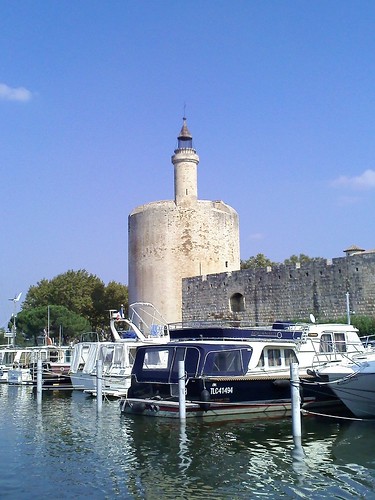
Only the Constance Tower remains of Louis' original fortifications. Its thick walls are considered impregnable, perfect for a prison. Following revocation of the Treaty of Nantes, which had granted Calvinists some freedoms in Catholic France, Aigues Mortes' walls were used to imprison the protestants. The tower of Constance was duly named after a female inmate who spent 38 years in captivity.
Over time, the shifting alluvial basin of the Rhone rendered the port of Aigues Mortes unnavigable to ocean-going vessels. This, in effect, served to preserve the medieval city. Its now regarded as one of the most complete medieval naval fortresses in Europe. As such, its a huge tourist draw. The crusader armies have been replaced by legions of retirees. Instead of riding horses through the city streets, tourists can board the senior train for a guided tour in five languages.
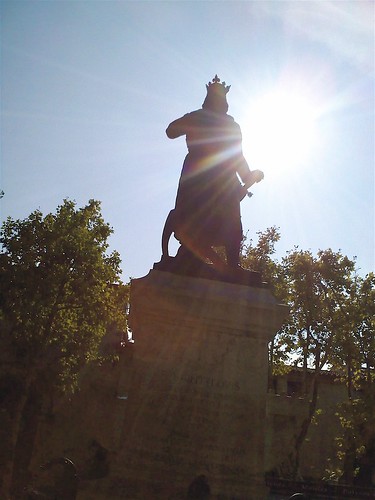
Despite its dangerous past and touristy present, Aigues Mortes is a unique and enjoyable city. After wandering around the ramparts, it's best enjoyed with a crêpe and café in the central square right in front of the statue of Saint Louis.
Growing up in rural Michigan, the county fair was always the highlight of the summer. As a 4-H kid, I spent the entire week at the fairgrounds. We were there every day feeding, cleaning, and showing our livestock. The most highly anticipated event of the week (except, of course, for the crowning of the 4-H king and Queen ;) was the Demolition Derby. We reveled in the barbarism, watching twisted heaps of metal collide and drivers frantically eject from their burning wrecks.
France has a parallel, never mind the sophisticated and stogy salons of Paris. Come down to the rural South of France, where real men test their mettle against Camargue bulls. And again, I'm not referring to the artfully choreographed bull fights popular in Spanish stadiums. No, I mean local untrained machisimo men in a pen with an angry bull and some rave-party foam and a pool of water and cotten-eyed-joe playing over the loud speaker. Now we're talking about entertainment.
Toros mousse is a spectacle. It's hard to believe that people would engage in such a sport. The most incredible aspect to me is that the guys jumping in the ring are just locals; they have no training. I could have jumped right in with the bulls too... if I was crazy. Young teens actually stand in between the high outer wall and an inner divider to get a better feel for the excitement. Sometimes, however, the bulls can jump over the first barrier, causing a wave of frantic leaping over boards an into the top ring of netting that confines the arena. At half time, all of the children are encouraged to run into the arena and play in the foam. They should be well prepared for frat foam parties at university.
After such years of indoctrination into the "sport," the men are willing to sacrifice their bodies for cash prizes and T-shirts. Now to be fair, they do cap the horns, so it's unlikely to get thoroughly gored - trampling is more likely.
There are some strategies. The bull doesn't see well in foam; making quick lateral maneuvers can save your tail. The bull tends to jump over the lip of the pool; while being pursued, if you duck under water against the edge of the pool, the bull will jump right over your position. This also earns you a point for successfully getting the bull in the pool. Finally, when fleeing toward the edge of the arena, be sure to plant off of the outer lip in order to spring over the inner boards and into the netting. Even if the bull makes the first jump, it will not have room to jump up after you. Instead, it will pursue the nearby spectators.
Really, you have to see it to believe it. I think toros mousse would impress even the most aggressive demo-derby enthusiast.