Saturday, October 24, 2009

GRR Airport

The second leg of my transcontinental US tour was Grand Rapids, MI. My plane touched down around 8:00 on Sunday night. We deplaned onto the tarmac but only had a short walk into the terminal. At that point, I was pleasantly surprised. I had expected a small concourse, but was greeted by a very familiar scene: rows of plastic chairs, a long walkway lined with golf-related business ads and a large crowd at the baggage claim.

IMG_3959

Stepping outside the building, I was again impressed by the modern structure confronting me. A large curved canopy extended between the parking garage across the street to the terminal building. Even though a conventional joist roof might have done the job, a cool pipe truss design emphasize the idea of the modern airport. Of course, I took lots of pictures.
Reblog this post [with Zemanta]

Desert Sustainability?

From the top of Camel Back mountain near Scottsdale, AZ you can view an incredible panoramic of the greater Phoenix area. In the distance, tall mountains hem in the desert valley. The city sprawls out encroaching on these natural barriers.

IMG_3932

Closer to the rock outcropping, multi-million dollar estates take their place on manicured golf courses. Some enterprising developers have even created desert oasis’s complete with palm trees and artificial lakes. The metro area thrives and continues to grow despite current economic conditions.

Is there something wrong with this scenario? Is man meant to live in the middle of a desert? Engineering prowess has enabled us to transport water for irrigation and human use long distances from highland reservoirs. Does the fact that we can do these things justify this desert existence?

IMG_3952

This week my brother is moving into a new home in Mesa. This community extends further into previously uninhabited areas of the desert valley. Anticipating substantial growth, speculators have invested in thousands of new homes and an extensive infrastructure. Large boulevards now seem unnecessarily large in these days before the residents have arrived. Affordable home prices promise to entice inhabitants to the new community.

The homes are large. My brothers place feels like a Mcmansion in comparison to my modest condo in downtown Chicago. The kitchen and dining room alone equal the size of my entire place. Large windows provide beautiful views of an adjacent golf course and distant mountain ridges. I can only imagine what cooling costs must be for such a home. I also reflect on the fact that temperatures were still reaching 100 degrees in late October.

IMG_3944

It does not seem responsible to build communities and homes modeled after those in temperate regions in the middle of the southern desert. People of all communities are entitled to comfortable and affordable housing, but we ought to make adjustments that permit a more harmonious relationship with the local environment.

A small class of artisans has set up such a model community in nearby Scottsdale, called Cosanti. The architecture, by Paolo Soleri, is almost reminiscent of the desert dwellers’ in Star Wars (whose scenes were actually filmed in the deserts of Tunisia). They subsist by selling artistic goods to visitors. To some extent outcasts, there is a religious-like belief in their sustainable way of life.

P1260030

Similarly, a number of native American tribes live modest lives on several southwest reservations. Despite being situated on poor lands, dictated by unsatable homesteaders, the Indians make do with limited resources. Increasingly, even they try to take advantage of anglo-american largess by opening nearby casinos. Perhaps we could learn much if we spent less time tossing dice and more time learning about their culture.

So this is the paradox of Phoenix: it’s a beautiful desert oasis with all the comforts of home, but at the cost of an entire nation’s freedom and an increasing environmental cost. I cannot help but feel that the city’s growth is unsustainable.

Reblog this post [with Zemanta]

Saturday, October 17, 2009

Flight of the Phoenix

Over the next three weeks, I will be back in the States attending multiple engineering conferences. My first destination was Phoenix to attend the National Council of Structural Engineering Associations annual conference. I'm on a committee about media relations and educational outreach. The conference was held well outside the city in a convention center in Fort McDowell.

My brother also lives in Scottsdale, so I was able to stay with him during the conference. It was great to see him again. Immediately before moving to France, I had attended his wedding in Phoenix.

One morning before my conference events, I went hiking up Camelback mountain - so named for the shape of the rocky profile from a distance. It is one of the steepest hiking ascents you'll find so near to civilization. With only a couple of hours to spend, I didn't even make it all the way up the 1.5 mile hike. Still, I was able to snap some panoramic views of the city.

IMG_3932

Monday, October 12, 2009

la Cathedral d'Images

The rocky hills around les Baux de Provence have long inspired visitors to the medieval city. It's rumored that Dante's description of hell was based on the apparent cascades of jagged rocky outcroppings. Others found an immaculate strain of mineral resources in the hills. Bauxite, a principle ingredient in aluminum, is so named because of its discovery near les Baux. Some entrepreneurs were content to exploit the pure white limestone itself.

picture0091

The monolithic limestone quarries are themselves inspirational architectural spaces. Massive passageways and expansive "rooms" are reminiscent of monumental Egyptian burial sites. Further considering the bright white limestone walls, reminiscent of so many churches, the mining sites are best described as cathedrals.

Within one such abandoned quarry, an artistic installation of picture and sound is on display. This year they are featuring the works of Pablo Picasso. When reading about the exhibition, I had expected something like a typical art museum - a series of still photos and solemn observers. The cathedral d'images provides a much different experience. Instead of static displays, the images constantly scroll through the vast walls of the quarry. Children dance on images projected onto the floor to dramatic tunes. The musical selection is diverse, juxtaposing the bull fighting anthems from Carmen with the serious theme from the Godfather. And yet, each selection fits the mood of the images appearing all around.

picture0084
Reblog this post [with Zemanta]

les Baux de Provence

Legend has it that Balthazar, one of the magi that followed the star of Bethlehem, later retired to the South of France and established the community now known as les Baux de Provence. The Provencal people seem to have a knack for inserting themselves into biblical relevance. Anothe rexample is the story of les Maries de la Mer, which now famously sets the premise for Dan Brown's DaVinci Code.

Though the story of the city's founding is historically dubious, there is a legendary quality to the ruined fortress perched at the top of an imposing hill. Throughout the middle ages, les Baux de Provence exemplified the era. Devious castellas sometimes inhabited the fortress, using their might to extort the local populace. The walls were fortified to thwart marauding moors. At least twice, the castle was besieged by rival factions. Knights and troubadours promulgated the myth of chivalry and honor within the walls of the keep.

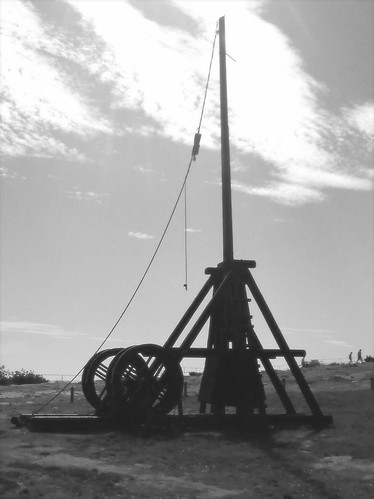
Today, the castle grounds are a sprawling museum for learning about the myths and truths of the middle ages. Little remains of the actual castle walls, having been ordered destroyed during the wars of religion. However, the installation of several replica siege machines and a thorough audio tour bring the hilltop fortress to life.

It seems that life in Les Baux was closely tied to rocky outcropping into which it was constructed. Many walls of the castle were simply carved out of the rock. Many peasants even made troglodyte homes within the soft stone. These rock walls survive where the man-made ramparts have fallen. As a result, it's interesting to note the ridges and corbels chiseled into the rock to receive wooden beams or act as washing basins. The local people even relied on the rock walls to receive water. Gutters were carved into the rock to channel water into cisterns.

picture0074

Medieval life was hard on the peasantry, but court life would have lacked many of the creature comforts that we cherish today as well. The keep of the castle is a small square shaft with limited lighting and only minimal opportunity for fireplace heating. Loyalty was also hot and cold. A duke hoping to replenish the ranks of his warriors with a mercenary knight or desiring some entertainment from a troubadour might well find his wife swept away into a courtly love affair by these supposed compatriots.

picture0065

Today, you're more likely to lose your wife among the maze of specialty shops in the small village. There is no permanent city to speak of, it's entire existence is based on a reputation as one of the most beautiful villages in France - and this is true.

View more photos of les Baux de Provence on my Flickr page.
Reblog this post [with Zemanta]

Rosés are only slightly red

The festival in Chusclan draws wine devotees from around France. Châteauneuf du Pape exports one of the most famous labels of red wine. But for a truly unique local wine, you must visit the sister cities of Lirac and Tavel, home of rosé wine preferred by kings.

picture0005 picture0004

Both villages have their own unique Appellation d'Origine Controlée. However, Tavel only produces rosé wines. It's said that Louis XIV and Philip IV traveled through the region and enjoyed the wine. According to legend, the latter declared Tavel's brand of rosé the only good wine in the world.

Like most Côtes du Rhône wines, grenache, syrah and mourvedre grapes are predominately used. But whereas many rosés are simply made by blending red and white wines, that process is strictly forbidden by French A.O.Cs. Instead, the grape skins are allowed to ferment with the wine for a short period of time. In Tavel, an extra step is added to the process allowing for a more powerful flavor from the wine.

The best thing about this local variety of Rosé: you don't need to wait for a long fermentation period in the cellar.
Reblog this post [with Zemanta]

Chateauneuf du Pape

Though Chusclan might have a local reputation for producing quality Côte du Rhône A.O.C. wines, it is by no means as internationally renown as Châteauneuf du Pape. This small wine-obsessed village is located just a few miles outside of Avignon, home to the Popes through much of the 13th century. During their reign, wine production benefited from their Papal influence. The latest techniques were applied and the vine stock greatly improved. The modern success of Châteauneuf de Pape is still linked to Avignon and the reputation that is spread by the numerous international visitors that visit the famous walled city.


Our trip to Châteauneuf du Pape was less based on touristic interests than our own appetite for good wine. We had asked some friends to check out our local wine super-store in Chicago to see if any of the local cooperatives were represented. Only one variety was widely available: the rouge of Châteauneuf du Pape. Though white and rosé wines are also produced, the region northeast of Avignon is most well-known for its deeply colored red wine.

Upon arriving in the small village, we proceeded to the office of tourism for some help in finding wine tasting venues. A light-up board provided our answer: go in any direction. The city is littered with mini-caves (pronounced in a Mayor Quimby way, as in cod) for tastings. We set a rule to avoid those with neon signs and flashing lights.

Our first stop was already being patronized by two east-coast Americans. They intimated that their wine selection was worth the hype. We tried a few rouge samples and settled on an aged bottle that agreed with our palate. The price was 27€, previously unheard-of in our wine tasting adventures. The best quality wine in Chusclan is less than half the price. Nevertheless, we were committed.

We continued up in the direction of the castle ruins at the top of the hill. On the way, we passed an unassuming cave in a cave-like cellar: Cave due Veger. Walking through the dimly lit passages, we encountered a large group of North Americans, well into a multi-flight tasting. We were encouraged to join in. The French wine-master began a quick recap of the tasting, beginning with some light white wines. He implored us to use our imaginations to pick out the various scents and flavors in the selections. In one case, he told the story of a child describing the smell of one wine as honey-nut Cheerios. The kid was exactly right.

We were scolded repeatedly for taking wimpy whiffs and holding the glass improperly. Never touch the bulb, it warms the wine and leaves ugly smudges during a meal.

To approximate the aged taste of the wine, he explained how to slurp the wine - like whistling backwards. Be careful, though, too much gusto and you'll look decidedly uncool coughing up your sample. Done right, we learned to feel the taste from the front of our mouth to the back of our jaw. Fruits up front, tobacco-like sensations in the back. A good classic French wine, we were told, should taste like the leather from an old set of worn farm boots deep in your palate. Fruity wines are for women.

All the while, the others in our tasting company peppered our host with food pairing questions. A gentleman from Atlanta wanted to know what would go best with grilled dates wrapped in goat cheese. Not to be outdone, the women from Ontario suggested some traditional Canadian fare. As casual observers this played out hilariously as we could read the wine experts impatience with such neophytes. Suspecting that the group on a privately run excursion would pay handsomely for his wares, he played along.

The final test came when we were presented with a fruity desert wine - like an ice wine, but not produced according to those rules. We were challenged to come up with six different fruits and and one flower. Mary Ann and I successfully guessed none of them, though our generic guess of citrus did in fact describe the most prominent taste of a ruby-red grapefruit. Who cares what was in the wine, it tasted good. We left with another $30 bottle of wine from Châteauneuf du Papes.
Reblog this post [with Zemanta]
 
Creative Commons License
This work by Ken Maschke is licensed under a Creative Commons Attribution-Share Alike 3.0 United States License.