Showing posts with label Castle. Show all posts

Monday, October 12, 2009

les Baux de Provence

Legend has it that Balthazar, one of the magi that followed the star of Bethlehem, later retired to the South of France and established the community now known as les Baux de Provence. The Provencal people seem to have a knack for inserting themselves into biblical relevance. Anothe rexample is the story of les Maries de la Mer, which now famously sets the premise for Dan Brown's DaVinci Code.

Though the story of the city's founding is historically dubious, there is a legendary quality to the ruined fortress perched at the top of an imposing hill. Throughout the middle ages, les Baux de Provence exemplified the era. Devious castellas sometimes inhabited the fortress, using their might to extort the local populace. The walls were fortified to thwart marauding moors. At least twice, the castle was besieged by rival factions. Knights and troubadours promulgated the myth of chivalry and honor within the walls of the keep.
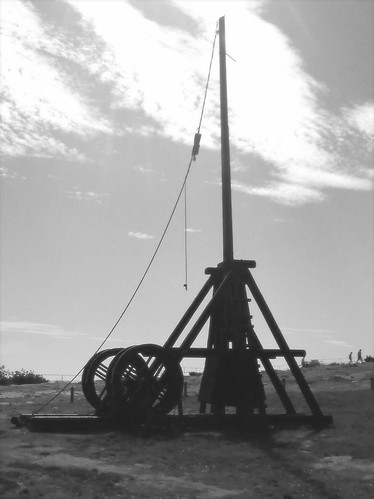
Today, the castle grounds are a sprawling museum for learning about the myths and truths of the middle ages. Little remains of the actual castle walls, having been ordered destroyed during the wars of religion. However, the installation of several replica siege machines and a thorough audio tour bring the hilltop fortress to life.

It seems that life in Les Baux was closely tied to rocky outcropping into which it was constructed. Many walls of the castle were simply carved out of the rock. Many peasants even made troglodyte homes within the soft stone. These rock walls survive where the man-made ramparts have fallen. As a result, it's interesting to note the ridges and corbels chiseled into the rock to receive wooden beams or act as washing basins. The local people even relied on the rock walls to receive water. Gutters were carved into the rock to channel water into cisterns.

picture0074

Medieval life was hard on the peasantry, but court life would have lacked many of the creature comforts that we cherish today as well. The keep of the castle is a small square shaft with limited lighting and only minimal opportunity for fireplace heating. Loyalty was also hot and cold. A duke hoping to replenish the ranks of his warriors with a mercenary knight or desiring some entertainment from a troubadour might well find his wife swept away into a courtly love affair by these supposed compatriots.

picture0065

Today, you're more likely to lose your wife among the maze of specialty shops in the small village. There is no permanent city to speak of, it's entire existence is based on a reputation as one of the most beautiful villages in France - and this is true.

View more photos of les Baux de Provence on my Flickr page.
Reblog this post [with Zemanta]

Tuesday, September 15, 2009

Storming a Castle

I just can't help myself. If I see a castle, I simply must find some way up to the gates, frequently to the chagrin of my companions. Not 30 minutes after telling my sister that we wouldn't be doing any hiking, I had us on the path to the fortress overlooking St-Victor-la-Coste.

"It's an easy hiking trail," I argued.

"You're not wearing flip-flops and a dress!" Nancy retorted.

Lesson learned? Doubtful. As ever, storming castles is risky business. Sometimes you lose friends and get locked in a dungeon.

picture0167 ken locked in
Reblog this post [with Zemanta]

Friday, August 21, 2009

Castles for Sale - Sold

You don't need to be the Queen of England to live in a castle - just rich or very lucky. Not all castles are national landmarks; many are private property. On several occasions, I've trekked up to the gates of a castle and found the entrance interdit - prohibited. This is slightly annoying after hiking up a long winding drive. I don't understand why they can't post the sign at the base of the hill.

These private chateaux are often much better maintained than those open to the public. The two most impressive personal castles that I've seen so far around Chusclan are le chateau de Jonquier and le chateau de Montfaucon.

Chateau de Montfaucon
chateau de Jonqier

Reblog this post [with Zemanta]

Friday, August 14, 2009

Typical Email

From: Ken Maschke
Subject: My day so far
To: "MASCHKE Mary Ann (EXT)"
Date: Friday, August 14, 2009, 8:19 AM

Sorry I haven't been answering your emails.

I got lost in the Gicon and was out for 3 hours. Biked to St. Etienne des Sorts, high winds going up the Rhone. Checked out a 12th century church there. Then tried to find my way to the chateau de Jonquier. Cut through some fields and peddled up a steep road just to find out it was private property. Tried to head over the gicon and find the trails I usually take. Saw a red marked trail, ignored my own rule: never take a trail marked red. Half hour later after pushing my bike up a rocky mountain trail and through thorny weeds. I ended up exactly where I started. Followed a stream bed, back to St. Etienne, much to my dismay. Then biked all the way back. Oh, and I fell once, not sure if my camera survived.

Will check out your links after I shower.

--Note: Camera did NOT survive--

Saturday, August 1, 2009

Vaison-la-Romaine

The Pax Romana, or Peace of Rome, encompassed two remarkable centuries of western history. From 27 B.C. to about 180 A.D., Rome consolidated its power within borders that included the entire Mediterranean region and extended as far north as the British Isles. It's thought that citizens could travel from Alexandria to Paris using the same currency throughout the trip and expect to find public servants speaking the same Latin language. At the same time, Roman architects and engineers were perfecting the art of city planning and constructing monumental population centers throughout the empire.

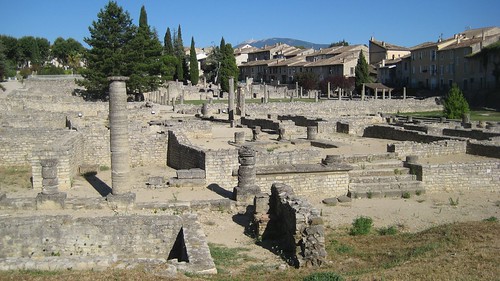
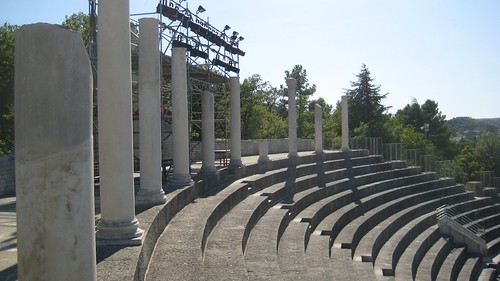
Roman influence penetrated well into the heart of France. In a relatively short time, the Gauls of southern France adopted Roman customs and began to flock to Roman cities. Vaison-la-Romaine was one such urban center. Located in the shadow of Mt. Ventoux, it seemed an unlikely site for a large roman settlement to me. However, it is home to one of the largest Roman archeological sites in France. A complete commercial center, a hillside theater, a bath-house and several huge residences can be seen among the ruins.


Most of the buildings' facades have long since deteriorated away, but the foundation walls and a series of (perhaps) reconstructed columns allow visitors to imagine the experience of walking through a Roman city. Walking along a street in the commercial district, you can visualize the merchants peddling their wares from their appointed stalls. Entering through one portal, visitors would have been greeted by a statue of Mercury, the Roman god of commerce. Continuing on through the interior courtyard, you might have seen where the daily cost of goods was negotiated - an ancient stock market of sorts.

The other side of town was home to the wealthiest Roman citizens. Their mini-palaces sprawled over multiple city blocks and often featured private gardens and baths. The servants and family lucky enough to live with such a patron could enjoy running water and state-of-the-art plumbing. Conveniently, these wealthy and politically connected residents lived closest to the city's theater.


Over time, however, the strength of the empire ebbed, under constant pressure from foes on all borders. In the ages following the fall of the Roman Empire, villagers moved into more defensible walled cities. Vaison-la-Romaine is also home to a walled medieval village. Standing tall on the highest rock outcropping within the city is an imposing citadel. Narrow cobble-stone streets wind gradually up to the masonry fortress.

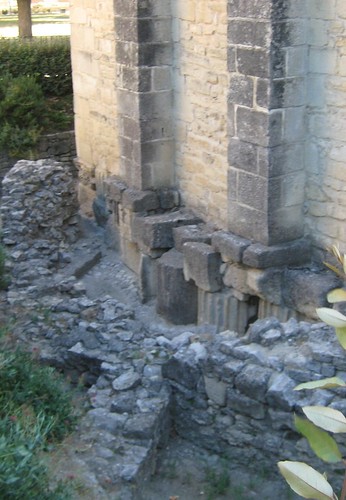
It's likely that much of the stone used to build the medieval city was mined from the ruins of the Roman structures. Excavations around the edge of a nearby church clearly show that Roman fluted column sections were used to create foundations for the church walls. The practice of recycling building materials is age old. It's clear that the medieval residents of the city has no qualms about historic preservation. However, later generations can be glad that they weren't more efficient in mining the Roman city.

View more of my photos of Vaison-la-Romaine on Flickr.
Reblog this post [with Zemanta]

Monday, June 8, 2009

Ancient History


Southern France is a dreamland for history buffs. A steep 5km hike up the hills behind our apartment will bring you to the remains of a 13th century castle. High on a rocky bluff, it once stood watch over the local bishop's lands. Now, it's the perfect place to view the surrounding vineyards. View more photos of my photos of Le Chateau de Gicon at Flickr.

On the opposite side of the Ceze River valley, you can find the ruins of a Roman town that claimed the surrounding lands long before the Catholic Church. The plateu is appropriately named Camp du Cesar. Foundations for the city's forum and temple are still visible, but the most impressive structure is a round tower tought to be the largest such Roman tower in Southern France. View more photos of my photos of Camp du Cesar at Flickr.
Reblog this post [with Zemanta]
 
Creative Commons License
This work by Ken Maschke is licensed under a Creative Commons Attribution-Share Alike 3.0 United States License.